



How floodwater can raise the barrier that holds it back
Some passive flood barriers use buoyancy to deploy as water rises. Their usefulness depends on the chamber, supports, seals and maintenance around the moving panel, and on choosing the right design for the site.
It’s Important
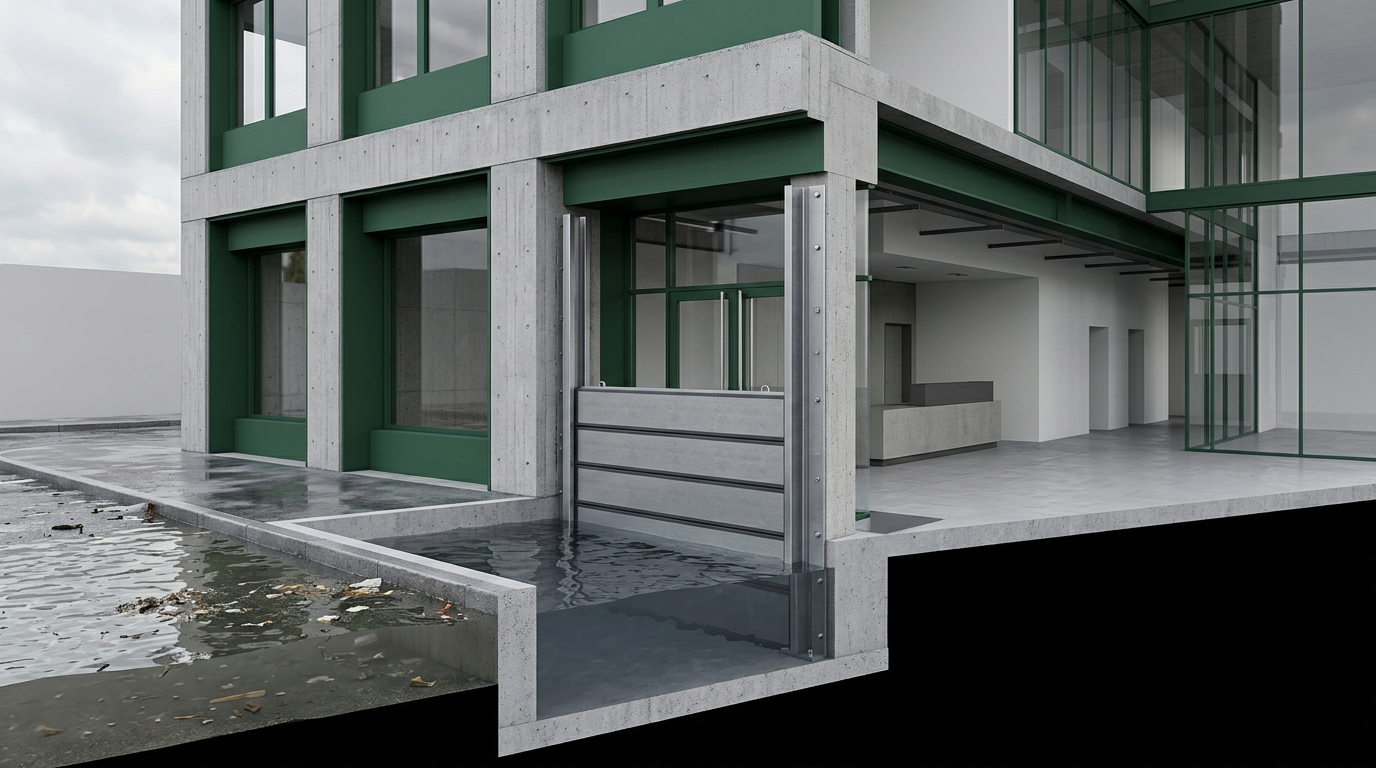
Water can provide both the threat and the force that deploys a flood barrier. Some passive systems use rising water to move a panel into position, reducing dependence on someone arriving to install it. The mechanism still relies on a carefully designed civil structure.[1]
The simplest explanation starts with a distinction: a barrier that rises vertically is different from a hinged panel that rotates upright. Both can use floodwater for deployment, but their moving parts and installation details are not interchangeable.[2],[3]
A wall that floats upward
In one vertically rising design, a buoyant panel normally rests below ground inside a trough. Water reaching a predetermined level enters through a service pit and pipe, filling the chamber around the panel. As buoyancy increases, the panel rises into its protective position.[2]
The upward movement is not the whole defence. In the manufacturer’s description, supports position the raised panel and the sealing arrangement closes the opening. The chamber, panel, supports and surrounding construction work together as a system.[2]
This deployment method does not require an electric motor to raise the panel. That is a useful property where power or rapid human intervention cannot be relied on. It does not imply that every supporting or reset function at every installation is entirely independent of power.[2],[4]
A separate design rotates on a hinge
Other passive barriers lie horizontally across an entrance or in a recess. Water flows beneath a buoyant panel, which rotates upward around a hinge. As the water recedes, the panel can return toward its resting position, depending on the particular design.[3]
The distinction matters for how an entrance is built and maintained. The flow path, moving clearances and mechanical connections belong to the specific system, even when the trigger in each case is rising water.
The water route needs maintenance
A passive trigger still needs a route for water to enter the chamber. The panel must have room to move, and the sealing and drainage arrangements need inspection. Manufacturer documentation calls for a maintenance plan and checks that the barrier rises and falls without snagging.[4]
Reset also depends on the site. A chamber may drain as surrounding water levels fall; some installations need pumping under particular drainage conditions. The correct process comes from the installed system’s documentation, rather than a universal rule for all passive barriers.[4]
Protection has a defined scope
A barrier is designed for particular dimensions and loading conditions. Its usefulness depends on how it fits the entrance, the adjacent structure and the routes water could take around it. It is reasonable to ask what the entire protected boundary can withstand, not only whether a panel moves automatically.[2],[3]
The important idea is therefore more complete than water lifting a wall. It is a deliberately maintained system that converts rising water into movement, then has to hold and seal against that same water.
Sources & Further Reading
- 1.
- 2.
- 3.Hydrodynamic passive flood barrier(opens in a new tab)
Flood Control Global
- 4.
- Content type
- Explainer
- Author
- It’s Important
- Published
- Reviewed
- Editorial basis
- Research-based editorial
Filed under Design topic · Water system · Cities system
Spotted an error? Report it to us.