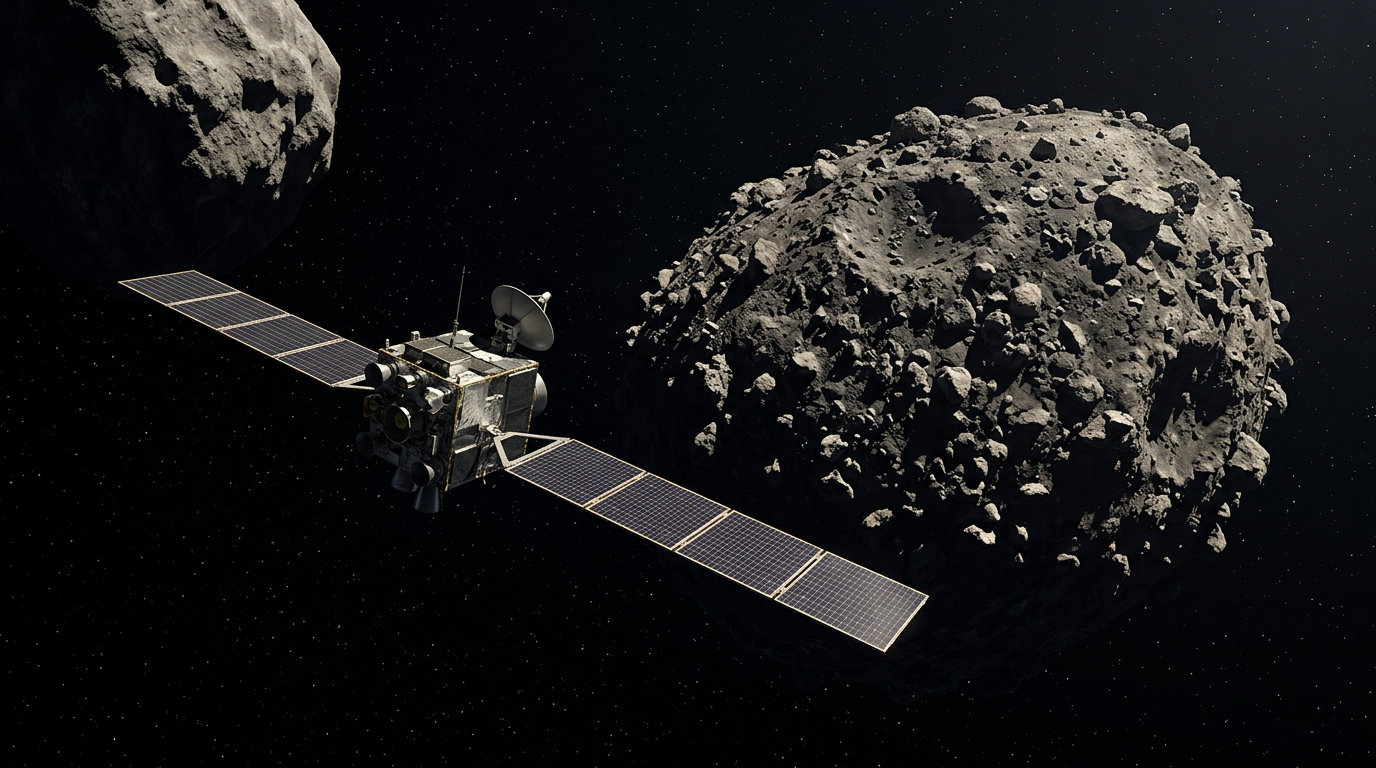




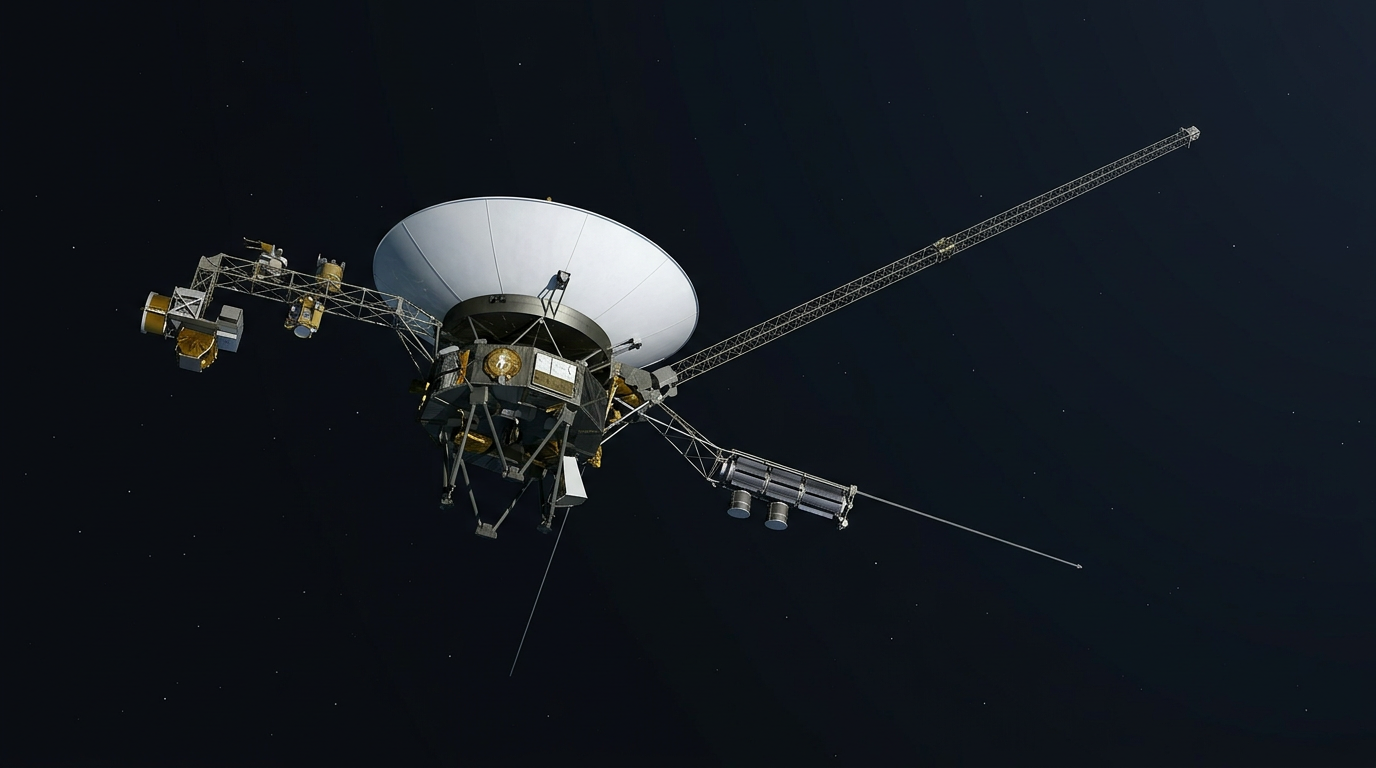
Voyager is one light-day away
A radio message now needs about a day to reach Voyager 1, and another day for an immediate reply to return. That distance makes the probe’s continuing operation a story about power, onboard protection and patient engineering.
It’s Important
Current context · as of
NASA confirmed the one-light-day milestone using Voyager 1’s carrier signal and trajectory calculations. Its 19 November update reported no science or engineering data received since 14 November. The data issue and the distance confirmation are separate facts.[1]
Voyager 1 reached one light-day from Earth on 18 November 2026. NASA confirmed the milestone the following day, after the spacecraft’s radio signal had completed the journey back. The probe was about 25.9 billion kilometres from Earth.[1]
The unit describes distance: the length light travels through a vacuum in 24 hours. Voyager took more than 49 years to reach that distance from Earth. Nothing aboard the spacecraft suddenly changed when it passed the milestone.[2],[3]
A conversation takes two days
Radio signals travel at the speed of light. A command sent from Earth therefore needs about 24 hours to reach the probe, and an immediate response needs roughly another 24 hours to return. The minimum round-trip delay is around 48 hours, before allowing for any additional waiting or work.[2]
That last distinction matters. A two-day propagation time is not a promise that a technical problem can be diagnosed and resolved in two days. Engineers still have to obtain useful information, interpret it and decide what to send next.
Some protection has to happen onboard
In October 2026, NASA reported a communications interruption during which one group of Voyager 1’s thrusters went offline and backup thrusters activated. The agency described this as an example of fault protection: onboard systems can respond to a detected problem by putting the spacecraft into a stable configuration.[3]
Such responses give the ground team time to investigate. At this distance, immediate intervention from Earth is physically unavailable, so decisions about what the spacecraft can handle for itself are part of the mission’s design.
Electricity is a declining resource
Voyager’s generators convert heat from decaying plutonium into electrical power. The available supply decreases by about four watts each year. Engineers have progressively reduced consumption, including switching off equipment and changing how some onboard functions are provided.[3]
This is an operating constraint, not just a sign of age. Every continuing function has to fit within an increasingly limited supply. Extending a mission requires choices about what remains essential and how to keep it working.
Contact is not the same as receiving data
NASA’s 19 November announcement reported that science and engineering data had not arrived from Voyager 1 since 14 November. A carrier signal remained detectable. The team combined that signal with trajectory calculations to confirm the distance milestone while continuing to analyse the data issue.[1]
The distinction prevents the celebration from obscuring the spacecraft’s condition. A radio signal can establish that a link persists even when useful telemetry is not arriving as expected.
The journey continues beyond the milestone
Launched in 1977, Voyager 1 studied Jupiter and Saturn before continuing outward. It crossed the heliopause into interstellar space in 2012. That boundary marks the edge of the Sun’s bubble of particles and magnetic fields, rather than the disappearance of the Sun’s gravity.[4]
One light-day makes the scale of the journey easier to express. Keeping a link across that distance remains a daily engineering task, shaped by the speed of light, the spacecraft’s remaining power and the hardware still working aboard it.
Sources & Further Reading
- 1.
- 2.
- 3.NASA’s Voyager 1 conserves power, resolves brief communications pause(opens in a new tab)
NASA Jet Propulsion Laboratory, 2026
- 4.
- Content type
- Explainer
- Author
- It’s Important
- Published
- Reviewed
- Editorial basis
- Research-based editorial
Filed under Space topic
Spotted an error? Report it to us.