


A robot has started building in orbit
Caltech’s ASTRA experiment assembled an initial structural section in space. The demonstration explores how future missions might build larger structures after launch, while revealing the practical work still ahead.
It’s Important
Everything sent into space has to survive launch first. It must withstand intense vibration and acceleration, and it must fit inside the protective nose cone, or fairing, at the top of a rocket. That space is measured in metres.
For many missions, that is enough. For others, it is the main constraint. Larger antennas can gather weaker signals, and larger telescope mirrors can observe fainter and more distant objects. Caltech notes that the size of such structures is currently limited by the size of rocket fairings.[1]
Two ways to make something bigger than the rocket
Since the beginning of space exploration, engineers have relied on two approaches. The first is to fold a structure for launch and unfold it in space. The second is to send large sections up over a series of launches and join them together in orbit.[1],[2]
Both work, and both have limits. A folded structure has to be designed around the volume it occupies during launch, and every hinge, latch and deployment step must perform correctly once it reaches orbit. Assembling large pieces across several launches allows a bigger result, but each piece must still fit inside a fairing, and joining them takes considerable effort.
Caltech describes the need for a third option: building structures in space from smaller parts.[1]
The ASTRA demonstration
On 5 November 2026, Caltech and the US Defense Advanced Research Projects Agency (DARPA) announced results from the Autonomous In-Space Tensioned Reflector Assembly, known as ASTRA. It is part of DARPA’s Novel Orbital and Moon Manufacturing, Materials and Mass-efficient Design programme, or NOM4D.[1],[2]
DARPA started NOM4D in 2022. ASTRA is one of two projects that reached the programme’s third phase, which consists of small-scale demonstrations in orbit. Its earlier phases developed the concept and design methods, then tested the approach in a laboratory on Earth.[1]
The payload, roughly one cubic metre in size, launched on 30 March 2026 from Vandenberg Space Force Base aboard SpaceX’s Transporter-16 mission. It travelled on Momentus Inc.’s Vigoride 7 vehicle, which hosted the experiment and provided communications, power and imaging support.[1],[2]
How the system builds
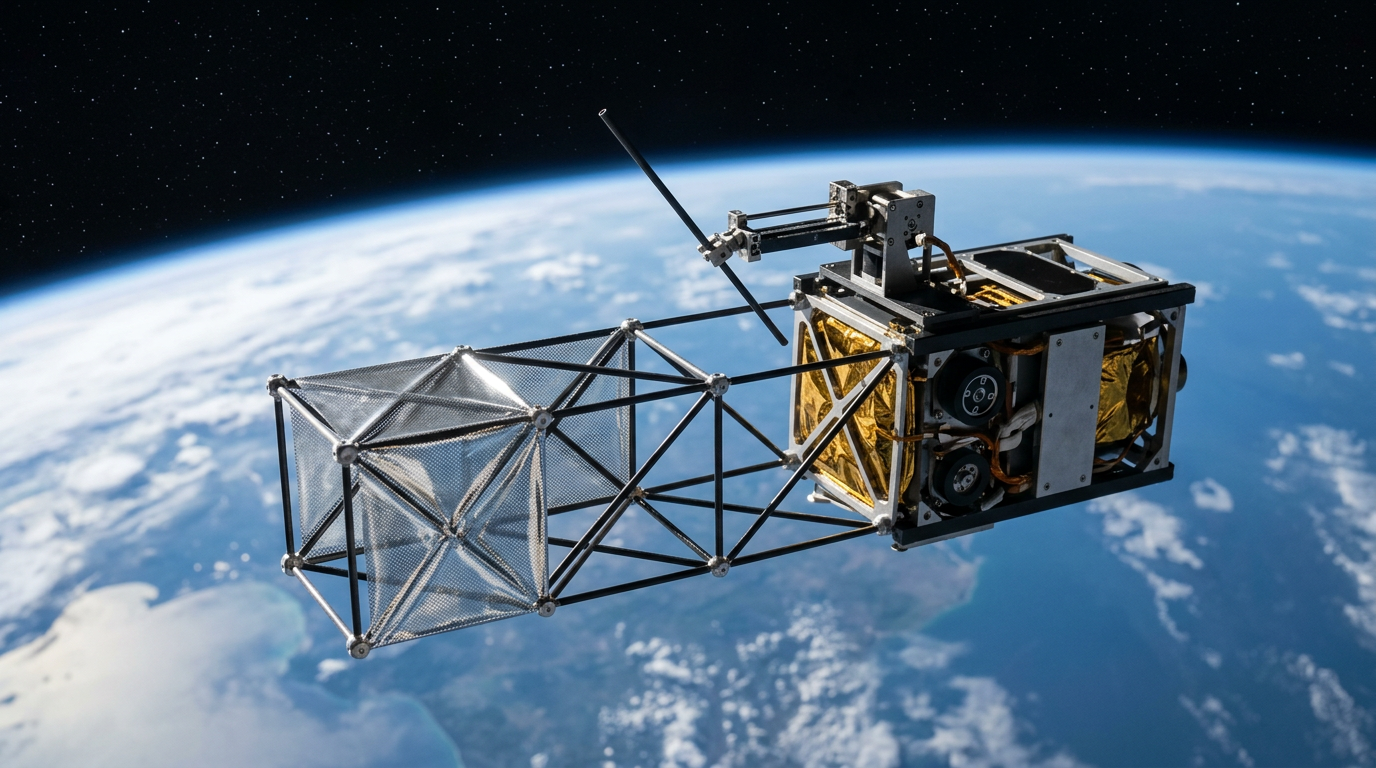
The goal was a 1.4-metre reflector antenna, made from composite fibre tubes, aluminium joints and a reflective surface. The supporting structure is a truss: a framework of straight members connected at nodes. ASTRA builds it from identical repeating sections called bays.[1]
DARPA describes the builder as a relatively simple gantry robot, one that moves along three straight axes. It picks up struts and joints from motorised dispensers, places them on an assembly plate and connects them into a bay. It then attaches a thin, perforated reflective film to form two cable nets held in tension by springs, and pushes the finished bay out of the box before starting the next.[2],[1]
The reflective film was co-invented by the Caltech team and collaborators at the University of Pennsylvania. According to Caltech, it needs less tension than the knitted metal mesh normally used in foldable reflectors, which allows lighter structures. DARPA compares the overall approach to construction toys, where pieces join at nodes one section at a time.[1],[2]
What actually happened in orbit
ASTRA carried two bays that had been built on the ground, along with the parts for the rest of the truss. Once in orbit, the team released the launch restraints and pushed the two prebuilt bays out of the builder. The robot then assembled a third bay in space.[1]
The full truss would require 11 bays. Caltech reports that the team ran into time limitations and was able to build only the initial section of the antenna. With the mission due to end in December, the university says completing the full truss appears unlikely.[1]
Caltech and DARPA both describe this as the first autonomous or automated construction of a structure in space. That is their characterisation of the result, and it refers to the third bay assembled in orbit, not to a completed antenna.[1],[2]
People on the ground
Autonomous assembly did not mean an independent mission. Team members sent commands to the onboard computer through the Vigoride vehicle and checked the results against photographs downloaded from space. Operations were repeated to work around unforeseen problems, of which Caltech says there were many.[1]
The team also built a twin of the payload, a flight spare kept in a Caltech laboratory. When an issue was confirmed in orbit, engineers tried to reproduce it on the spare, tested possible solutions and then sent the workaround to the system in space. They could communicate with it only during roughly seven or eight windows a day, each about 15 minutes long.[1]
Why a partial result still counts
An unfinished antenna might sound like a failed experiment. In engineering, a demonstration in the real environment is often valuable precisely because it reveals what laboratory tests cannot.
Caltech reports that the team learned enough to show the assembly approach is viable, and that the design needs to be simplified and refined. DARPA’s programme manager, Andrew Detor, noted that operating in space leaves virtually no margin for addressing problems, and that testing in the operational environment is instrumental to maturing the technology quickly.[1],[2]
What the evidence supports is narrower than a working construction system. ASTRA showed that a simple robot could assemble a bay of this design in orbit, with considerable help from the ground. It did not show that the method is ready to build large structures reliably, quickly or without close supervision.
What it could lead to
The longer-term ambitions are much larger. DARPA says NOM4D’s objective is to enable construction of structures hundreds of metres or kilometres in scale, and acknowledges that nothing approaching that scale can be achieved today.[2]
Caltech points to possible uses including large reflectors for space telescopes, the apertures of large radio antennas and very large solar arrays for space-based solar power. DARPA also mentions space depots and habitats. These are potential applications of the general approach. None of them was demonstrated by ASTRA.[1],[2]
The idea behind them is that a future mission could be launched as a compact box of building materials and assembled where it will operate. DARPA notes that the benefits would vary by structure, and that automated assembly suits large, low-mass designs in particular.[2]
Testing where it matters
Methods for building in space can be modelled and rehearsed on Earth, but only orbit shows how they behave with real launch loads, real communication limits and the many small surprises the ASTRA team described.
One bay is a modest structure. It is also a measured result from the place where future large structures would have to be built, and that kind of evidence is how ambitious engineering becomes dependable engineering.
Sources & Further Reading
- 1.
- 2.
- Content type
- Explainer
- Author
- It’s Important
- Published
- Reviewed
- Editorial basis
- Research-based editorial
Filed under Space topic
Spotted an error? Report it to us.