




Starship’s first orbital catch, and the work after it
Catching Starship after its return from orbit brought a major piece of hardware back to the launch site. Making that recovery repeatable, and turning it into another flight, remains a separate engineering task.
It’s Important
Current context · as of
Starship’s upper stage was caught at Starbase after Flight 15. The Super Heavy booster was lost after diverting offshore. This mission did not recover both stages, and the successful catch alone does not demonstrate routine rapid reuse.[1],[3]
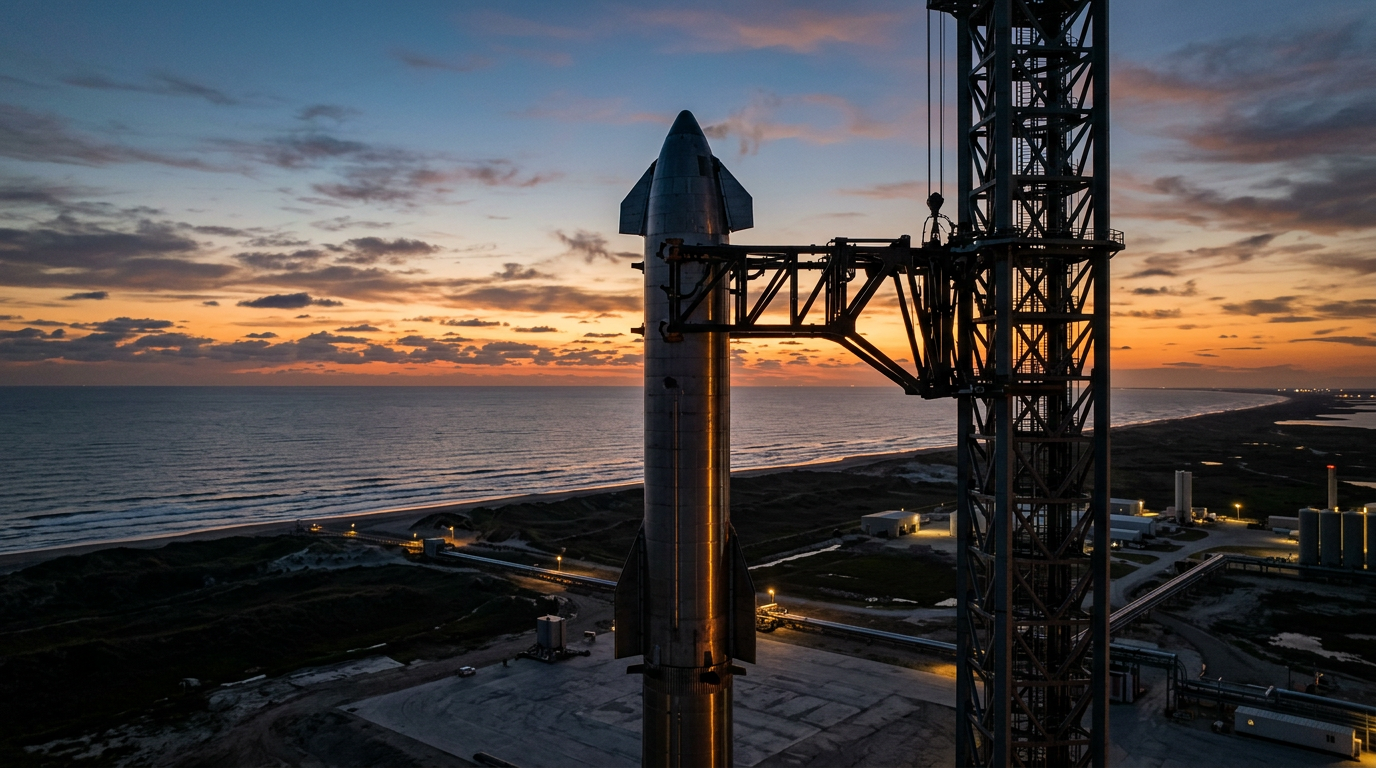
On 14 November 2026, SpaceX caught Starship’s upper stage at its Starbase launch tower after the spacecraft returned from orbit. The ship had launched the previous day and spent more than 22 hours in space.[3]
The same mission did not recover the entire rocket. Its Super Heavy booster diverted offshore and was lost, ending the planned attempt to recover both stages on one flight. The upper-stage catch was a major result within an incomplete recovery mission.[1]
The two stages have different journeys
Starship is a two-stage system: Super Heavy provides the initial boost, while the upper stage continues the mission. SpaceX’s design aims to bring both back for reuse, using the launch tower’s mechanical arms to support the returned vehicles.[2]
The upper stage’s task includes returning from orbital flight, controlling its descent and reaching the tower in a condition suitable for recovery. Flight 15’s published plan made that return conditional on checks of systems needed for reentry, landing and final approach. Returning to the site was not an unconditional instruction regardless of vehicle health.[1]
A catch starts before the arms close
After reentry, the ship turned upright and used a landing burn to slow its descent toward the tower. The arms supported the vehicle as the recovery concluded.[3]
The spectacle concentrates attention on the last few seconds. The engineering result depends on the chain before them: flight, thermal protection, guidance, propulsion and the approach all have to leave the vehicle in a recoverable state. The tower is the final part of that chain.
Recovery and reuse answer different questions
SpaceX describes the system’s intended operating cycle as recovery, inspection, refurbishment and another launch. Those steps make clear why returning a vehicle and operating it repeatedly are related but separate achievements.[2]
A recovered ship provides hardware that can be examined after the flight. From an engineering perspective, that makes it possible to compare the vehicle’s actual condition with the expectations behind its design. The resulting work may concern repair, changes for later vehicles or preparation for another mission.
Routine rapid reuse would require that cycle to be completed consistently. A successful catch by itself does not establish the time, labour or replacement parts needed before reflight. Nor does it establish a particular reduction in launch cost.
The milestone is substantial and specific
Flight 15 brought an orbital upper stage back to its launch site for a tower catch. It also left the booster unrecovered. Both facts belong in an account of what happened.[1]
The next useful evidence is operational: what inspection reveals, what has to change and how recovered hardware performs when it flies again. The promise of reuse becomes practical through that continuing cycle.
Sources & Further Reading
- 1.
- 2.
- 3.
- Content type
- Explainer
- Author
- It’s Important
- Published
- Reviewed
- Editorial basis
- Research-based editorial
Filed under Space topic
Spotted an error? Report it to us.