



How a spacecraft can push an asteroid off course
NASA’s DART mission demonstrated that a spacecraft impact can change an asteroid’s motion. The useful lesson is about momentum, early detection and understanding the target, rather than a last-second rescue.
It’s Important
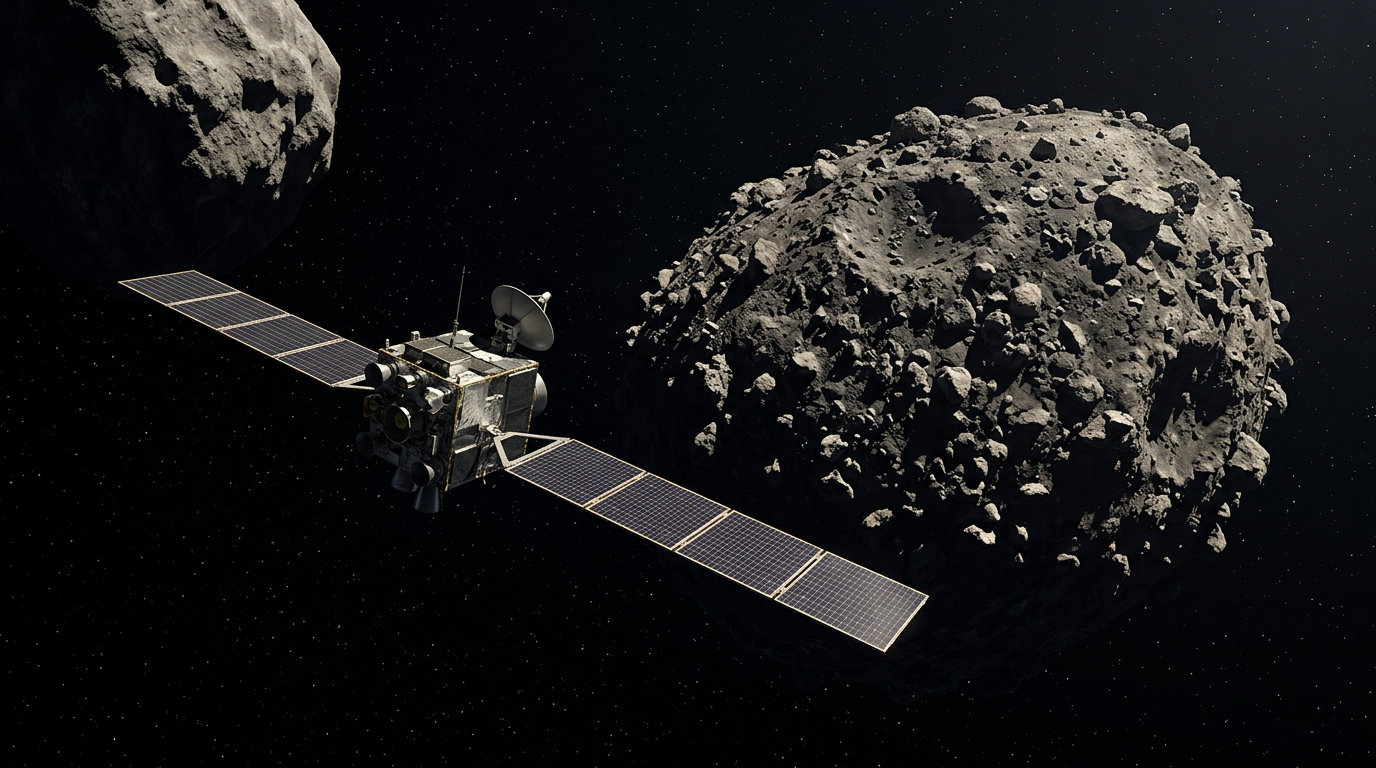
An asteroid does not have to be destroyed for its future path to change. A spacecraft can transfer momentum by deliberately colliding with it. Given enough time, a small change in motion can lead to a meaningful difference in where the object will be later.[1]
That is the principle behind a kinetic impactor. NASA tested it with the Double Asteroid Redirection Test, or DART, which struck Dimorphos on 26 September 2022. The test target was not on a collision course with Earth.[2]
A measurable test without an Earth threat
Dimorphos is a small asteroid that orbits the larger Didymos. Their arrangement gave researchers a way to measure a change in motion by comparing the smaller body’s orbital period before and after impact. DART’s task was to reach the target and alter its movement in a controlled demonstration.[2]
The initially reported period change was later refined through further observation. A 2024 analysis found that Dimorphos’s orbit around Didymos had settled at about 33 minutes and 15 seconds shorter than before impact. That number describes the time for one orbit around Didymos; it is not an amount of time removed from a predicted Earth impact.[3]
The escaping material adds a push
The spacecraft supplies momentum when it strikes. The impact also throws asteroid material into space. That ejecta can give the remaining asteroid an additional recoil, so the result depends on more than the spacecraft’s mass and speed alone.[2]
This is one reason the physical nature of the target matters. How material is packed and how it responds to impact influence the motion that follows. Researchers also found substantial changes in Dimorphos’s shape, adding evidence that the impact altered the body as well as its trajectory.[3]
The effect extends beyond the small orbit
Research reported by NASA in 2026 found that DART also changed the Didymos system’s orbit around the Sun. The result connects a measurable local impact with the larger orbital motion relevant to planetary defence. It does not turn one test into a ready-made plan for every future asteroid.[4]
Time makes a small change useful
A deflection has to be designed around a known object and a calculated future encounter. The earlier a threatening object is understood, the more time there is for a carefully chosen change to accumulate. A spacecraft cannot be assumed to produce the same outcome on every asteroid.[1],[2]
Discovery, tracking and characterisation therefore belong in the same story as the impact. They establish what the target is doing, what intervention might achieve and how the result could be checked. The collision is one step in that chain, rather than the whole defence.
DART demonstrated a physical capability. Turning that capability into protection for a particular future threat would require the slower work of finding the object early, understanding it and choosing a mission suited to its orbit and structure.
Sources & Further Reading
- 1.
- 2.
- 3.NASA study: Asteroid’s orbit, shape changed after DART impact(opens in a new tab)
NASA Jet Propulsion Laboratory, 2024
- 4.
- Content type
- Explainer
- Author
- It’s Important
- Published
- Reviewed
- Editorial basis
- Research-based editorial
Filed under Space topic
Spotted an error? Report it to us.