
Mars may still be volcanically active
Unusual gas detections near Alba Mons suggest a possible connection to magma below Mars’s surface. Understanding the finding means following the chemistry, the instruments and the uncertainty.
It’s Important
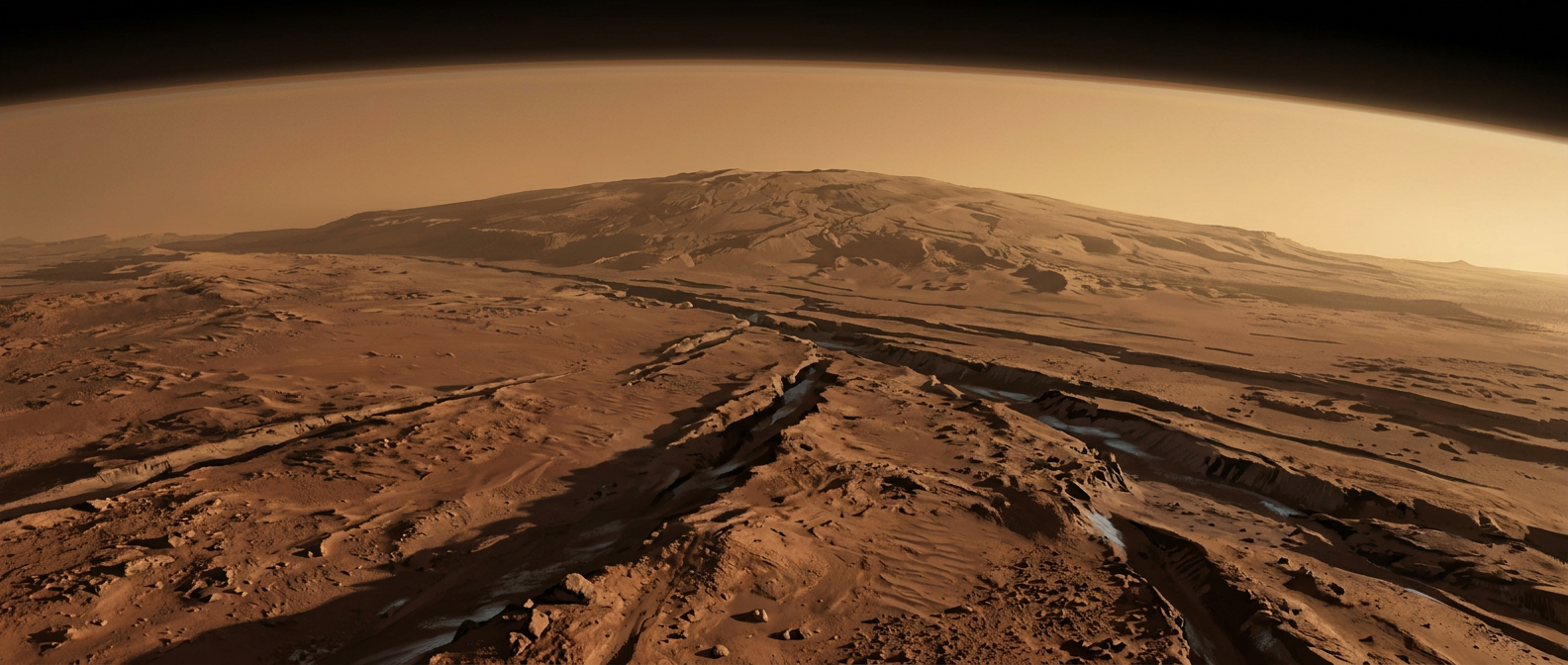
Mars’s cold surface can make its geological history feel finished. Yet the planet’s atmosphere may carry clues to processes that remain hidden underground.
Research announced on 4 November 2026 points to unusual hydrogen chloride detections near Alba Mons, a Martian volcano. The researchers propose that the gas could be connected to magma below the surface.[1]
The significance lies in the explanation: how a faint atmospheric signal becomes a hypothesis about the interior of another planet.
The gas was already a puzzle
Hydrogen chloride, written chemically as HCl, contains hydrogen and chlorine. Its presence on Mars was first reported in 2021, using observations from the ExoMars Trace Gas Orbiter.
Those earlier measurements included detections during the global dust storm of 2018. The gas appeared across widely separated locations, and scientists did not see the accompanying gases they would have expected from a straightforward volcanic explanation.
They therefore investigated chemistry involving the surface and atmosphere. Winds can lift salty dust. Reactions involving that material and water vapour can release chlorine and produce hydrogen chloride. A gas associated with volcanoes on Earth can have another explanation on Mars.[2]
Further research described by Japan’s Institute of Space and Astronautical Science linked seasonal HCl increases to dust and found similarities between the altitude profiles of HCl and water vapour. Its rapid disappearance also raised questions about how the gas is removed.
To interpret a detection, scientists need to understand both how a substance appears and how it disappears.[3]
The timing and location stood out
The Alba Mons observations drew attention because they departed from the broader seasonal pattern.
Oxford’s account describes repeated detections in early northern summer, above fractures in the same volcanic region. That combination of timing and location led researchers to examine whether a local source underground could help explain the signal.[1]
This distinction matters. A planet-wide chemical cycle and a local release can involve the same molecule. The molecule’s identity alone cannot distinguish them.
How an orbiter reads an atmosphere
Detecting a trace gas does not require photographing a visible plume.
The Trace Gas Orbiter carries instruments that study how light interacts with the atmosphere. Its Atmospheric Chemistry Suite and NOMAD spectrometers measure different wavelength ranges to investigate atmospheric composition and its changes over time.
In an observing technique called solar occultation, an instrument looks towards the Sun through the planet’s atmosphere. Different molecules absorb particular wavelengths, leaving patterns that can identify their presence. Those patterns allow researchers to investigate gases present in very small quantities.[4],[5]
Surface imaging provides a different kind of evidence. The orbiter’s CaSSIS camera was designed to complement atmospheric measurements by examining geological features that might be connected to gas sources.[4]
The strength comes from combining observations. Atmospheric chemistry supplies a signal to explain; surface geology supplies a setting in which possible explanations can be assessed.
A possible route from below
The team examined narrow fissures and surface colour changes around Alba Mons. Their proposed explanation links these fractures to gas release from magma at depth.
Seasonal ice could help control when that release becomes detectable. In the suggested mechanism, ice blocks pathways during winter. As it sublimates—changing directly from solid to gas—those pathways become available again.[1]
That sequence connects several parts of a system: an underground source, routes through rock, a seasonal barrier and an atmospheric measurement.
It is a hypothesis that brings those observations together. The connections still need to withstand further investigation.
What the finding establishes
An atmospheric measurement and an interpretation of its origin are different levels of evidence.
The reported signal provides something to investigate. Connecting it to magma requires an explanation of how the gas forms, travels and survives long enough to be detected.
No modern eruption or new lava flow was observed. The proposed gas release could occur without a surface eruption.[1]
The finding should also be read alongside the earlier atmospheric work. Dust, water vapour and ice already belong in the explanation of Martian hydrogen chloride. Any account of a local underground source has to distinguish its contribution from those processes.[2],[3]
The useful position is to hold the observation and its interpretation together, while keeping their different levels of certainty visible.
Why habitability enters the discussion
Heat, water and rock can interact to create environments of interest to astrobiology.
NASA’s Jet Propulsion Laboratory studies hydrothermal systems because they can provide heat and chemical energy relevant to habitability. Its work includes using environments on Earth as analogues for conditions that might have existed on Mars, and developing ways to distinguish biological chemistry from processes that occur without life.[6]
That is the broader context for interest in possible underground heat. If suitable water and rock are present, heat could contribute to a system worth investigating. Each part of that conditional statement needs evidence.
NASA’s Mars science objectives distinguish the search for life from the study of habitability. Establishing that an environment offers suitable conditions is a different task from finding evidence that organisms occupy it—or ever did.[7]
Hydrogen chloride is not evidence of Martian life. A proposed connection to magma does not establish a functioning hydrothermal environment at Alba Mons.
It gives scientists a reason to investigate whether more of the necessary pieces could be present.
A more specific place to look
The next steps follow from the gaps in the explanation.
Further observations could test whether the gas returns under comparable seasonal conditions. Atmospheric models and laboratory chemistry can help assess competing sources and removal processes. Closer geological investigation could help determine how the fractures formed and what they connect to.
These are directions suggested by the evidence, rather than a claim that any single future observation will settle the matter.
The importance of the finding is that it makes a large question more concrete. Scientists have a location, a chemical signal and a proposed mechanism to test.
A few molecules cannot reveal an entire planetary interior. They can help decide where to look next.
Sources & Further Reading
- 1.European orbiter detects hints of volcanic activity on Mars(opens in a new tab)
University of Oxford, Department of Physics, 2026
- 2.ExoMars discovers new gas and traces water loss on Mars(opens in a new tab)
European Space Agency, 2021
- 3.Source and sink of hydrogen chloride in the atmosphere of Mars(opens in a new tab)
JAXA Institute of Space and Astronautical Science, 2021
- 4.Trace Gas Orbiter instruments(opens in a new tab)
European Space Agency
- 5.How ExoMars studies the atmosphere(opens in a new tab)
European Space Agency, 2018
- 6.Research directions — Origins and Habitability Laboratory(opens in a new tab)
NASA Jet Propulsion Laboratory
- 7.
- 8.
- Content type
- Explainer
- Author
- It’s Important
- Published
- Reviewed
- Editorial basis
- Research-based editorial
Filed under Space topic
Spotted an error? Report it to us.