



What Happens When Space Stops Being Rare?
Reusable rockets and more frequent launches are changing access to orbit. The important question is no longer only whether we can reach space, but what happens when getting there becomes routine.
It’s Important
A rocket launch is still a spectacle. It is also becoming less unusual.
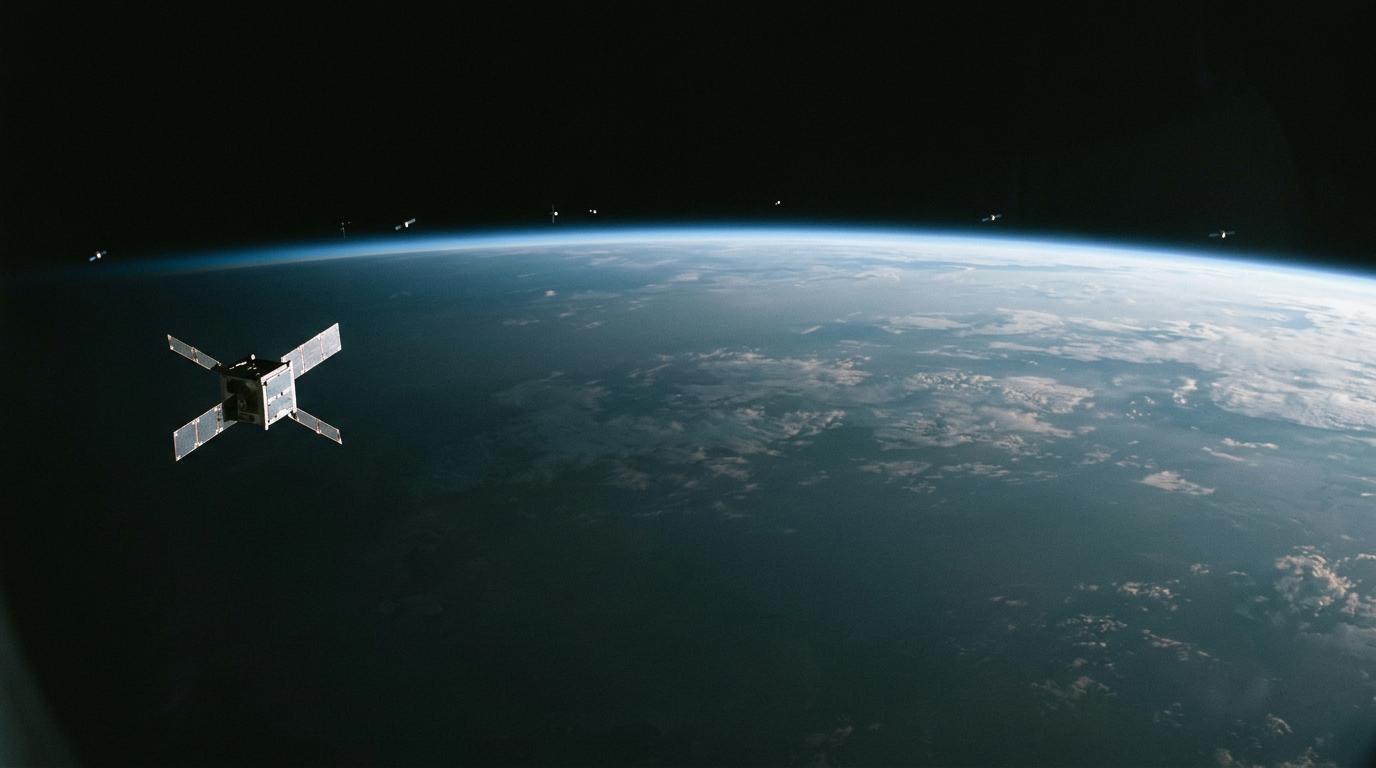
For most of the space age, reaching orbit took large government programmes, years of preparation and launch vehicles that were thrown away after a single flight. Today, parts of some launch vehicles routinely return to Earth and fly again, launch schedules are much denser, and commercial operators carry payloads for governments, researchers and companies. Thousands of satellites now work above us.
World Space Week, held each year from 4 to 10 October, has chosen “Rocket Revolution” as its 2026 theme. The organisers frame it around reusable rockets, falling launch costs and the arrival of commercial providers and new national space actors. The phrase points to a real technological shift. The more interesting question comes after the rocket leaves the pad: what changes when access to space becomes less exceptional, and what new problems become important?[1],[2]
This piece is independent editorial coverage timed to the occasion. It is not affiliated with, sponsored by or produced for World Space Week.
The launch was once the bottleneck
Getting anything into orbit is hard for physical reasons that have not changed. A spacecraft in low Earth orbit has to travel at roughly 7.8 kilometres per second, and nearly all the mass of a rocket on the pad is propellant needed to reach that speed. The payload is a small fraction of what lifts off. Small margins in engine performance, structural mass or guidance decide whether a mission reaches orbit at all.
For decades that physics was paired with an expensive architecture. Most rockets were expendable: every stage, engine and tank was built for one flight and then fell into the ocean or burned up. Each launch meant building a new vehicle. Because launches were costly and infrequent, payloads were designed to justify the expense. They were large, heavily tested, built to last many years and often unique. Infrequent launches reinforced high costs, and high costs kept launches infrequent.
Partial reuse had been tried before. NASA’s Space Shuttle flew 135 missions between 1981 and 2011 with a reusable orbiter and recoverable solid rocket boosters. Its experience showed that reuse alone does not guarantee lower costs. What matters is how much work a vehicle needs between flights, and how often it flies.[3]
Reusability changes the equation, not the physics
The current change rests on recovering the most expensive part of a rocket, usually the first stage with its engines, landing it under its own power and flying it again. Several operators now do this, and others are developing it. In Europe, ESA’s Themis programme is building a demonstrator stage designed to launch, land vertically and fly again, powered by a reusable, methane-fuelled engine.
ESA describes Themis as a demonstrator for low-cost recovery and reuse, and its engine, Prometheus, as designed to be restartable and about ten times cheaper than the engine on Europe’s current heavy launchers. Restarting matters because a returning stage has to fire its engine again to slow down and land.[4]
It is tempting to say reusability makes launch cheap. That is too simple. Reuse removes the need to build a new first stage for every flight. In exchange, it adds costs: recovery operations, inspection and refurbishment, and the propellant and performance spent on returning the stage instead of carrying payload. Whether the trade pays off depends on how quickly a stage can be turned around, how many times it can fly, how many launches a year spread the fixed costs of factories, pads and teams, and what each mission needs.
A reused stage also produces something an expendable one cannot: flight data from hardware that has actually been to space and back. Frequent flight lets engineers learn faster, find weak points and change designs between missions. Some of the gains attributed to reuse come from that operational learning as much as from the recovered hardware.
So lower launch cost and cheap access to space are not the same thing. The price of a seat on a rocket can fall a long way while building, insuring and operating a spacecraft stays expensive.
Launching more often matters as much as launching more cheaply
The scale of the change is clearest in launch frequency. ESA’s Space Environment Report 2026, based on data to the end of 2025, records more than 300 launches in 2025 and over 4,000 new payloads placed in orbit, about ten a day. ESA notes that large constellations and rideshare missions mean more satellites are deployed per launch, and that single-payload missions are becoming rarer.[5]
Frequency changes how space projects are planned. When launch opportunities are rare, a missed slot can delay a mission by months or years, and every spacecraft has to be close to perfect before it leaves the ground. When launches are frequent, satellites can be deployed in batches, failed units replaced and designs improved from one generation to the next. Large constellations depend on exactly this: they would be impractical if every launch were a rare event.
Not every mission benefits equally. A spacecraft heading to a distant planet still depends on a narrow launch window and a specific trajectory, and a large telescope still needs a particular vehicle that can carry it. Frequent launches to low Earth orbit help most with missions that are small, can be replaced, and can share a ride.
Small satellites changed the payload side too
Launch is only half of the story. Over the same period, satellites themselves became smaller. Miniaturised electronics, standardised designs and commercial components made it possible to build useful spacecraft the size of a shoebox. The CubeSat standard, built from 10-centimetre units, gave universities and small teams a common format that launch providers could accommodate as secondary payloads.
Through its CubeSat Launch Initiative, NASA arranges launch opportunities for CubeSats built by U.S. educational institutions and non-profit organisations, describing it as a low-cost pathway to science investigations and technology demonstrations. NASA says the programme has launched more than 150 CubeSats.[7]
Rideshare missions, where dozens of small spacecraft from different owners share one rocket, combine these trends. Smaller organisations can buy a slot on a scheduled launch rather than paying for an entire vehicle. That is a real change in access. It does not make small satellites simple, though. Many still fail early in their missions, and designing hardware that survives launch vibration, vacuum, radiation and extreme temperatures takes skill, testing and time.
Who actually gets access?
The expansion of launch is often described as the democratisation of space. Part of that is true. Countries without their own rockets can buy launches commercially. Universities can fly student-built satellites. Small companies can put Earth-observation or communications hardware into orbit without first building a launch vehicle.
But launch is only one layer of access. Before a satellite can fly, someone has to design, build and test it. They have to secure a national licence and register the object, coordinate radio frequencies so that its signals do not interfere with others, arrange financing and often insurance, integrate it with the rocket, and build or rent ground stations to talk to it once it is up. Each step needs skilled people and money, and each is governed by rules that vary by country.
Cheaper launches lower one barrier among many. Whether access becomes broader in practice depends on the rest: training, regulation, spectrum, financing and the ground infrastructure that turns a satellite into something useful. The risk is that falling launch prices mainly benefit those who were already well placed to use space, while the other barriers remain.
What becomes possible
Much of what satellites do is quiet and practical. The UN Office for Outer Space Affairs lists the everyday contributions of space applications: environmental monitoring, natural resource management, weather forecasting, climate modelling, satellite navigation, communications and early warning systems for disasters.[8]
Disaster response shows how this works across borders. Under the International Charter: Space and Major Disasters, authorised users, typically national disaster management authorities, can request satellite data through a single access point that operates around the clock at no cost. Analysed disaster maps can follow within hours or days.[9]
More frequent launches make it easier to keep such services running: to replace ageing satellites before they fail, add sensors that revisit the same place more often, and test new instruments in orbit before committing to large missions. The benefit is not the launch itself. It is the continuity of observation and communication that easier launches help sustain.
Orbit is not empty
The same growth that makes space more useful also makes it more crowded. According to ESA’s Space Environment Report 2025, using data to the end of 2024, about 40,000 objects were tracked by space surveillance networks, of which about 11,000 were active payloads. ESA estimated that more than 1.2 million debris objects larger than 1 centimetre, large enough to cause catastrophic damage, were in orbit, including over 50,000 larger than 10 centimetres.[6]
Some altitudes are especially busy. ESA found that around 550 kilometres, a popular range for communications constellations, the number of debris objects posing a threat is now of the same order of magnitude as the number of active satellites. The International Astronomical Union’s Centre for the Protection of the Dark and Quiet Sky counted more than 13,000 launched satellites from large constellations at the time of writing.[6],[10]
The deeper concern is not only the number of objects but how they interact. Fragmentation events, such as explosions of leftover fuel or deliberate anti-satellite tests, add thousands of pieces at once. ESA’s 2026 report states that even with no further launches, the debris population would keep growing because collisions and break-ups create fragments faster than the atmosphere removes them. This self-sustaining cascade is known as the Kessler syndrome. ESA’s Space Environment Health Index, which compares the current trajectory with a sustainable benchmark, rose from about 4 to about 50 in a single year.[5]
Projections like these rest on modelling assumptions about future launches, compliance and collision rates, and they will change as behaviour changes. The direction, though, has been consistent across years of reports.
More spacecraft means more coordination
Operators in busy orbits now routinely move their satellites to avoid predicted close approaches, called conjunctions. ESA reports that the number of events requiring collision-avoidance procedures in low Earth orbit rises each year, and its 2026 report notes that constellations increasingly change altitude from year to year, making the orbital landscape harder to predict.[6],[5]
Avoiding collisions depends on space situational awareness: tracking objects, predicting their paths, sharing that information and agreeing who moves. Much of this still relies on national tracking networks, commercial data providers and voluntary coordination between operators. There is no single global traffic-control system for orbit comparable to air traffic control.
Rules are tightening, but unevenly. In 2019 the UN Committee on the Peaceful Uses of Outer Space adopted Guidelines for the Long-term Sustainability of Outer Space Activities, which states are encouraged to implement voluntarily. In 2022 the U.S. Federal Communications Commission required satellites in low Earth orbit under its authority to be disposed of within five years of completing their missions, replacing the long-standing 25-year guideline. ESA has adopted a similar five-year standard for its own missions.[8],[11],[6]
Compliance is improving. ESA reports that controlled re-entries of rocket bodies have outnumbered uncontrolled ones since 2024. It also warns that not enough satellites leave congested orbits at the end of their lives, and that preventing new debris is no longer enough: some active removal will be needed.[5]
The atmosphere is part of the system too
Launch and re-entry also affect the air. Here it helps to separate what has been measured from what has been modelled and what is still unknown.
Measured: during NOAA-led research flights in 2023, scientists found metals from re-entering spacecraft and rocket stages in about 10% of stratospheric sulfuric acid particles larger than about 120 nanometres. Over 20 elements were detected in ratios consistent with spacecraft alloys. For lithium, aluminium, copper and lead, the mass from re-entry already exceeded what arrives naturally from meteors. The authors wrote that the effect of this metallic content on the stratospheric aerosol layer is unknown, and that planned satellite growth could put such metals in up to half of these particles.[12]
Modelled: rockets inject soot, or black carbon, directly into the stratosphere, where it can persist far longer than near the ground. A 2022 modelling study found that a sustained emission of 10 gigagrams a year, a scenario consistent with substantial future launch growth, could warm parts of the stratosphere by up to about 1.5 °C and reduce ozone in the Northern Hemisphere. Another modelling study, published in 2024, examined aluminium oxide particles formed when satellites burn up and suggested they could contribute to ozone depletion as large constellations are replaced over time.[13],[14]
Unresolved: how large these effects will be depends on future launch rates, propellant types, satellite materials and re-entry patterns, all of which are uncertain. ESA’s 2026 report describes atmospheric pollution from re-entries as a concern quickly gaining relevance and says the first task is to collect data on its extent and details.[5]
None of this makes rockets a major driver of global climate change today. Their emissions are small compared with aviation or power generation. The stronger question is different: effects that were negligible at a few dozen launches a year may not stay negligible at several hundred, especially because the stratosphere responds differently from the air near the ground.
Astronomy has a stake too
Satellites reflect sunlight, and in long-exposure images they leave bright streaks. A study of archival images from the Zwicky Transient Facility, a wide-field survey telescope in California, found that the share of twilight images crossed by Starlink satellite streaks rose from less than 0.5% in late 2019 to 18% in August 2021. The authors also reported that the survey’s science operations were not yet strongly affected at that time, and that sun visors added to newer satellites reduced their brightness by a factor of about 4.6.[15]
The concern extends beyond optical telescopes. The International Astronomical Union says it is deeply concerned about the growing number of satellite constellations, and through its Centre for the Protection of the Dark and Quiet Sky it works on reducing their effects on both optical and radio astronomy, as well as on people’s view of the night sky. The Centre lists dozens of large constellations in planning.[10]
Mitigation is possible and is happening in part: darker coatings, visors, adjusted orbits, data sharing so observatories can schedule around satellites, and software to remove streaks. These reduce the problem but do not remove it, and their effectiveness depends on cooperation from every operator, not just the largest.
Is launch still the bottleneck?
For most of the space age, the hardest part was getting off the ground. If that becomes easier, the constraint does not disappear. It moves.
It may move to orbital capacity, as certain altitudes fill up. It may move to radio spectrum, which is finite and shared. It may move to regulation and coordination, which are slower to change than technology. It may move to spacecraft reliability and end-of-life disposal, to the ground stations and data systems needed to use what is in orbit, or to the atmosphere and the night sky, which were never designed to absorb a steady stream of new objects.
There is no single answer, and the next constraint may differ from one orbit, one country or one type of mission to another. The pattern is familiar from other infrastructure. When a road becomes faster, traffic grows to fill it. When something becomes cheaper to produce, the question shifts to what happens to everything it leaves behind. Technological progress often moves the bottleneck rather than eliminating it.
An entrance, not an ending
For decades, the launch was the climax of a space mission. Increasingly, it is the beginning of a long period in a shared environment.
If reaching orbit continues to become more routine, progress will not be measured only by how often we launch or how cheaply. It will depend on whether the systems around launch develop quickly enough to make that access sustainable: regulation, orbital coordination, debris prevention and removal, scientific understanding of the upper atmosphere, and protection of the sky that astronomy depends on.
Making space easier to reach changes the question. The harder part is deciding what to do with that access once we have it.
Sources & Further Reading
- 1.World Space Week: 4–10 October annually(opens in a new tab)
World Space Week Association
- 2.World Space Week 2026 Celebrates the “Rocket Revolution”(opens in a new tab)
World Space Week Association, 2026
- 3.
- 4.Themis(opens in a new tab)
European Space Agency
- 5.ESA Space Environment Report 2026(opens in a new tab)
European Space Agency, 2026
- 6.ESA Space Environment Report 2025(opens in a new tab)
European Space Agency, 2025
- 7.
- 8.Long-term Sustainability of Outer Space Activities(opens in a new tab)
United Nations Office for Outer Space Affairs
- 9.What is the Charter?(opens in a new tab)
The International Charter: Space and Major Disasters
- 10.IAU Centre for the Protection of the Dark and Quiet Sky from Satellite Constellation Interference(opens in a new tab)
International Astronomical Union
- 11.FCC Adopts New “5-Year Rule” for Deorbiting Satellites (FCC-22-74)(opens in a new tab)
Federal Communications Commission, 2022
- 12.Metals from spacecraft reentry in stratospheric aerosol particles(opens in a new tab)
Proceedings of the National Academy of Sciences, 2023
- 13.The climate and ozone impacts of black carbon emissions from global rocket launches(opens in a new tab)
Journal of Geophysical Research: Atmospheres, 2022
- 14.Potential ozone depletion from satellite demise during atmospheric reentry in the era of mega-constellations(opens in a new tab)
Geophysical Research Letters, 2024
- 15.Impact of the SpaceX Starlink satellites on the Zwicky Transient Facility survey observations(opens in a new tab)
The Astrophysical Journal Letters, 2022
- Content type
- Analysis
- Author
- It’s Important
- Published
- Reviewed
- Editorial basis
- Research-based editorial
Filed under Space topic
Spotted an error? Report it to us.