


How Ebola Outbreaks Are Actually Stopped
No single drug or vaccine ends an Ebola outbreak. Detection, laboratories, care, tracing, vaccination, safe burials and public trust have to work together, and the weakest link sets the pace.
It’s Important
Current context · as of
As of 23 September 2026, WHO reported 7,890 confirmed cases of Bundibugyo virus disease in the Democratic Republic of the Congo, including 3,799 deaths, across 63 health zones in seven provinces. WHO declared the epidemic a public health emergency of international concern on 17 May 2026. Uganda’s outbreak was declared over on 27 August 2026. Outbreak figures change; this explainer focuses on how Ebola responses work rather than keeping a live case count.[2],[9],[3],[10]
Ebola outbreaks are rarely ended by a single breakthrough. They end when a set of demanding, mostly unglamorous tasks are done well at the same time: finding cases, tracing everyone they were in contact with, caring for patients safely, burying the dead with dignity and keeping the trust of the communities at the centre of it all.
The World Health Organization describes outbreak control as a package: intensive supportive care, infection prevention and control, surveillance and contact tracing, laboratory services, safe and dignified burials, vaccination where relevant, and social mobilisation. Every item on that list depends on the others. This explainer walks through what each one involves and why the response is only as strong as its weakest part.[1]
One clarification first. “Ebola” is not a single virus. Ebola disease is caused by several related orthoebolaviruses. Three are known to cause large outbreaks: Ebola virus (formerly Zaire ebolavirus), which causes Ebola virus disease; Sudan virus; and Bundibugyo virus. The distinction matters, because the vaccines and medicines available differ between them.[1]
01 — First, the outbreak has to be detected
Every response starts with someone noticing that something is wrong. Early Ebola symptoms (fever, fatigue, muscle pain, headache) look like many common illnesses, including malaria and typhoid. The incubation period, from infection to the onset of symptoms, ranges from 2 to 21 days. The first cases of an outbreak are often treated as something else, sometimes in ordinary clinics without special precautions.[1]
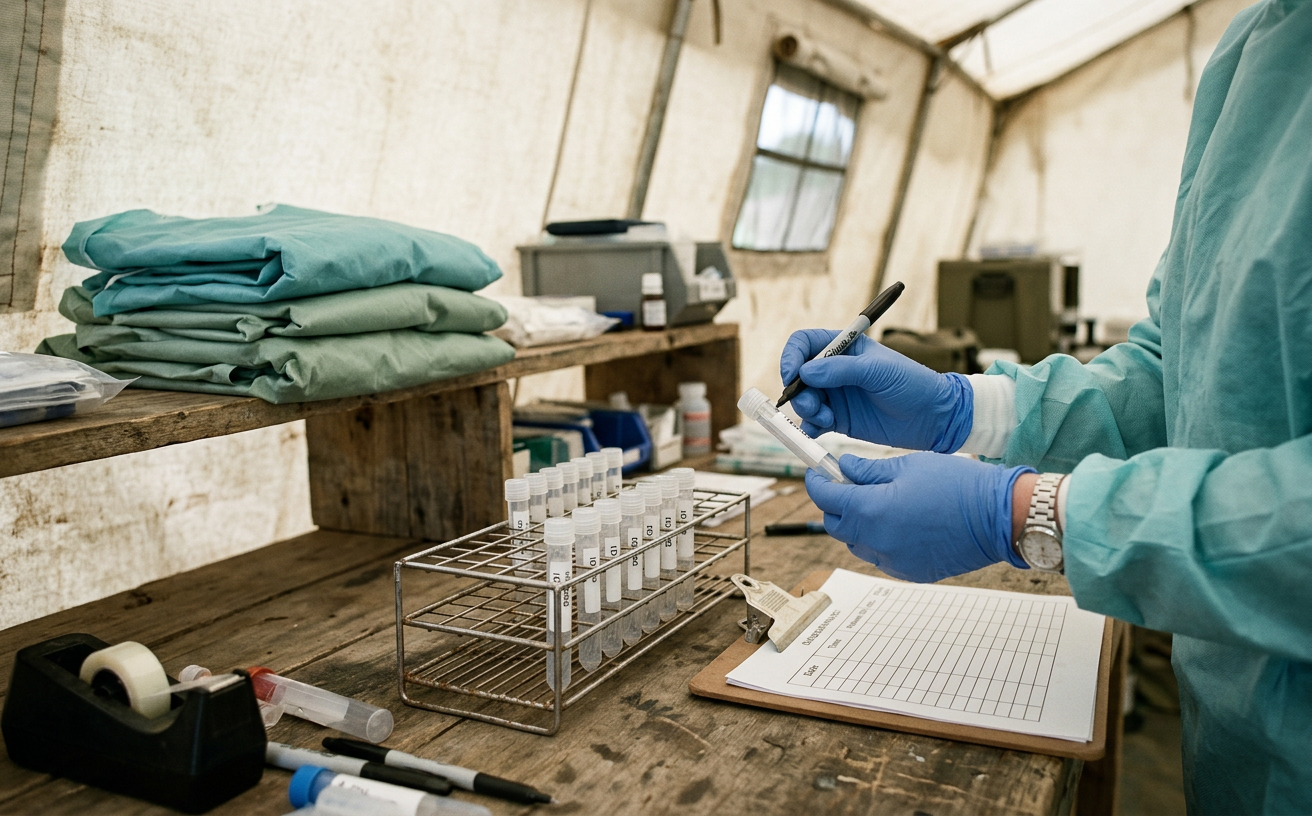
Suspicion becomes confirmation only in a laboratory. A sample must be collected safely, transported, often across long distances, and tested, usually by PCR. Each step takes trained staff, cold chains, reagents and roads. The more remote the community, the longer the gap between the first case and the first confirmed result.
That gap is where outbreaks grow. Each undetected case can pass the virus to family members, caregivers and health workers before anyone knows to protect them. Fast detection is not just a statistic. It decides how many transmission chains the response must chase once it starts.
Detection also shapes the numbers everyone relies on. In the 2026 Bundibugyo outbreak, WHO noted that the crude case fatality ratio appeared to be about 20% in mid-May 2026, because deaths among people still under investigation had not been counted. By 12 August 2026, as surveillance improved, it stood at about 46%. Early figures in any outbreak should be read as provisional.[3]
02 — Find the chain of transmission
Ebola spreads through direct contact with the blood or other bodily fluids of a person who is sick with, or has died from, the disease, and through materials contaminated with those fluids. It is not considered an airborne disease in the way measles or influenza are. That is why outbreaks can be traced: transmission follows people and their contacts.[1]
Once a case is confirmed, investigators ask where the person has been and who they touched, cared for, shared a home with or sat beside in a clinic. Each of those people becomes a contact. A contact is not a case: most contacts never become ill. The aim is to watch them closely enough that, if symptoms appear, they are isolated and treated within hours rather than days.
This is hard to do well. WHO’s Emergency Committee reported in August 2026 that, although about 80% of listed contacts were being followed up in the Bundibugyo outbreak, an average of only 13 contacts were listed per case, and only about 20% of new cases were identified through contact follow-up. When most new cases come from outside the contact lists, transmission is running ahead of the response.[3]
Contacts are followed for 21 days, the maximum incubation period, usually with daily visits or calls to check for fever and other symptoms.[1]
The most useful measure of how well a response is going is often not the total case count, but the share of new cases that were already on a contact list when they fell ill. A high share means the response is ahead of the virus. A low share means transmission is happening in places the response cannot yet see.
Contact tracing is labour-intensive, and it gets harder as outbreaks grow. In the 2018–2020 outbreak in eastern Democratic Republic of the Congo, WHO reported that responders followed up more than 250,000 contacts over the course of the response, often in areas affected by armed conflict.[8]
03 — Isolate safely
People with suspected or confirmed Ebola need to be cared for apart from others, in facilities set up to protect the people around them. Treatment and isolation centres separate suspected cases from confirmed ones, control the flow of people and materials, and manage contaminated waste.
Inside, infection prevention and control is the core discipline. WHO recommends standard precautions for all patients regardless of diagnosis, including hand hygiene, safe injection practices and personal protective equipment. Health workers caring for suspected or confirmed Ebola patients should apply additional measures to prevent contact with blood, body fluids and contaminated surfaces or materials.[1]
Protective equipment is only part of it. The riskiest moment is often taking it off, so teams are trained to remove each layer in a set order, frequently with a colleague watching. Supplies must be continuous. A centre that runs out of gloves, chlorine or water stops being a barrier and becomes a risk.
This matters beyond the treatment centre. Health facilities have amplified Ebola outbreaks when unrecognised patients were treated alongside others. Protecting health workers protects the system itself: every infected nurse or doctor is one less person able to care for patients, and a reason for communities to fear the clinic.
04 — Treat patients
Ebola is often described only through its death rate, but survival is common and care improves it. WHO reports that the average case fatality rate is around 50%, varying from 25% to 90% in past outbreaks, depending on the virus, the population and access to care.[1]
The foundation is optimised supportive care: replacing lost fluids and electrolytes, managing pain, nutrition and symptoms, and treating co-infections such as malaria. In June 2026, WHO published its first comprehensive clinical-management guidelines covering all filovirus diseases, including every type of Ebola and Marburg virus, and stressed early supportive care as central to survival.[1],[6]
For Ebola virus disease specifically, there are now approved treatments. The PALM randomised trial, run during the 2018–2020 outbreak in the Democratic Republic of the Congo, found lower mortality among patients given either of two monoclonal antibody treatments than among those given the comparison therapies. Mortality was markedly lower for patients treated early in their illness. Those two treatments, Inmazeb and Ebanga, are approved for Ebola virus disease.[14],[1]
They do not cover every Ebola virus. WHO notes that there are no approved therapeutics for Sudan virus disease or Bundibugyo virus disease, the cause of the 2026 outbreak. For those diseases, supportive care is the treatment, and candidate medicines are evaluated through clinical trials.[1],[6]
Treatment centres therefore do two jobs at once. They give patients the best chance of surviving, and they remove infectious people from homes and communities. The two jobs reinforce each other: when people see that patients come home alive, they are more willing to come forward early, which improves survival and shortens transmission chains.
05 — Vaccinate around cases, where a vaccine fits
Ebola vaccination is usually not a mass campaign. The established approach is ring vaccination: vaccinating the contacts of a confirmed case, and the contacts of those contacts, to build a ring of immunity around each chain of transmission. It was tested in the Ebola ça Suffit! trial in Guinea in 2015, which found that the rVSV-ZEBOV vaccine gave substantial protection against Ebola virus disease when used this way.[13]
That vaccine, now licensed as Ervebo, is recommended for outbreak response to Ebola virus disease, and health and care workers can also receive it preventively. In the 2018–2020 outbreak in the Democratic Republic of the Congo, more than 303,000 people were vaccinated.[1],[8]
Vaccine applicability is where precision matters most. Ervebo targets Ebola virus, not Sudan virus or Bundibugyo virus, and WHO lists vaccination as an outbreak measure “only for Ebola virus disease”. In August 2026, during the Bundibugyo outbreak, WHO and Africa CDC welcomed an allocation of Ervebo to the Democratic Republic of the Congo: 20,000 doses for a Phase 3 clinical trial and 50,000 for frontline and health workers, in line with recommendations from WHO’s immunisation advisers. WHO noted that it is not known whether Ervebo protects against Bundibugyo virus in humans; the trial is meant to find out.[1],[5]
Even where a well-matched vaccine exists, it does not replace the rest of the response. Ring vaccination only works if contact tracing has found the ring. A vaccine is a powerful tool inside a working system, not a substitute for one.
WHO’s Emergency Committee made the same point in August 2026: vaccines and therapeutics for Bundibugyo virus disease, if proven safe and effective, should complement rather than substitute for rigorous core public health measures.[3]
06 — Safe and dignified burials matter
The bodies of people who have died of Ebola disease remain highly infectious, and burial practices involving direct contact with the body, such as washing, touching or embracing the deceased, have contributed to transmission.[1]
The response is not simply to take bodies away. Safe and dignified burial teams are trained to handle remains with protective equipment while respecting the family’s wishes and religious and cultural practices wherever possible: allowing relatives to watch, involving religious leaders, naming the deceased and marking the grave.
The word “dignified” is load-bearing. Burials carried out by unfamiliar teams in full protective suits, without family involvement, can feel like a second loss. When that happens, families may hide deaths or hold burials in secret, which is exactly when transmission is most likely. Burials done with communities, not to them, are both safer and more likely to be accepted.
07 — Trust can decide whether the response works
Every step above relies on people choosing to cooperate: reporting symptoms, naming contacts, accepting isolation, agreeing to a supervised burial. WHO calls community engagement key to controlling any outbreak.[1]
Trust is easily lost. Treatment centres can be seen as places people go to die, particularly early in an outbreak, when many patients arrive late and do not survive. Rumours spread faster than official messages. Where people have lived through conflict, neglect or broken promises, they may reasonably be wary of outsiders who arrive suddenly with vehicles, protective suits and instructions.
What tends to work is less dramatic: recruiting response staff from affected communities, working through local leaders, religious figures, traditional healers and women’s groups, answering rumours directly and honestly, and showing visible results such as survivors returning home. Communication has to be two-way. Communities raise practical concerns about lost income, stigma and how loved ones are treated, and responses that address them earn cooperation.
The 2026 response shows how central this is. In August 2026, Africa CDC and WHO called for an urgent scale-up of a community-led response in the Democratic Republic of the Congo, with stronger early detection, contact follow-up, access to care and support for frontline health workers.[11]
Coercion tends to backfire. When people fear the response more than the disease, they stop coming forward. WHO’s Emergency Committee also noted in 2026 that the outbreak was unfolding where health services were already strained by a deteriorating humanitarian situation, funding cuts, attacks on health facilities and disrupted supply chains. Trust does not grow easily in those conditions.[3]
08 — Crossing borders changes the response
Viruses do not stop at borders, and many Ebola outbreaks begin in border regions with heavy movement of traders, families and displaced people. Once cases appear near or across a border, response becomes a regional task.
In practice, that means shared surveillance data, laboratory capacity on both sides, coordinated contact tracing for people who travel, and screening and follow-up of travellers where it is useful. In June 2026, Africa CDC and WHO launched a joint continental plan for the Bundibugyo outbreak, covering coordination, surveillance, laboratory testing, infection prevention and control, clinical care, community engagement, research and logistics.[12]
Travel bans are not the default answer. Under the International Health Regulations, WHO issues temporary recommendations to affected and other countries. Those issued in August 2026 ask countries to strengthen surveillance at airports, ports and ground crossings and to share information on contacts who may have crossed a border, while stating that neither suspending flights from affected countries nor denying entry to travellers arriving from them is recommended. Sweeping bans can push travel onto unofficial routes, delay supplies and responders, and discourage open reporting.[4]
Regional coordination can work. Uganda, which also reported cases in 2026, declared the end of its outbreak on 27 August 2026 after completing the 42-day countdown, and its experience was studied for lessons applicable across the border.[10],[11]
09 — When is an Ebola outbreak actually over?
A day with no new cases does not mean the outbreak is over. Someone infected yesterday may not show symptoms for up to three weeks, and a missed chain of transmission can surface after a long silence.
The end of an Ebola outbreak is therefore declared by countdown. Following WHO recommendations, an outbreak can be declared over 42 days (two full incubation periods of 21 days) after the last confirmed patient has tested negative for the virus and been discharged. When the Democratic Republic of the Congo declared the end of an outbreak in Kasai Province on 1 December 2025, it did so after exactly that 42-day period.[7]
Declaring the end is not the same as stopping work. A period of heightened surveillance follows, typically 90 days, so that any re-emergence is detected quickly. Risk communication and community engagement continue, including support to reduce stigma against survivors.[7]
Survivors also need ongoing care. Many experience lasting health effects, and some viruses can persist in parts of the body after recovery, which is one reason follow-up programmes for survivors have become part of how responses are planned.
10 — What stopping Ebola really requires
Seen as a whole, an Ebola response looks less like a medical intervention and more like a temporary public system built under pressure: surveillance networks, laboratories, roads and cold chains, isolation centres, contact tracers, burial teams, communicators and supply lines, all working at once.
An outbreak ends not because of one intervention but because detection, laboratories, healthcare, tracing, vaccination, logistics, communication and trust work together. When one fails, the others carry more weight, and when several fail, the virus wins time.
This is why the most important Ebola work often happens before an outbreak begins: in health systems that can recognise an unusual illness, laboratories that can confirm it, clinics with gloves and running water, and communities that have reason to trust the people who arrive to help. That is the system behind the headline, and it is what we will keep returning to in this collection.
This article is for general informational and editorial purposes and is not medical advice. For guidance about your own health, or about an outbreak where you are, consult a health professional or your national public-health authority.
Sources & Further Reading
- 1.Ebola disease — Fact sheet(opens in a new tab)
World Health Organization
- 2.Disease Outbreak News: Ebola disease caused by Bundibugyo virus – Democratic Republic of the Congo(opens in a new tab)
World Health Organization, 2026
- 3.
- 4.
- 5.WHO and Africa CDC welcome the allocation of Ebola vaccines to the Democratic Republic of the Congo(opens in a new tab)
World Health Organization, 2026
- 6.WHO issues comprehensive guidelines on filovirus disease, including Ebola and Marburg disease(opens in a new tab)
World Health Organization, 2026
- 7.Disease Outbreak News: Ebola virus disease – Democratic Republic of the Congo (end of outbreak)(opens in a new tab)
World Health Organization, 2025
- 8.
- 9.
- 10.Uganda ends Ebola outbreak following completion of 42-day countdown(opens in a new tab)
WHO Regional Office for Africa, 2026
- 11.Africa CDC and WHO call for urgent, community-led action to contain Ebola in the DRC(opens in a new tab)
World Health Organization and Africa CDC, 2026
- 12.Africa CDC and WHO launch joint continental Ebola response plan(opens in a new tab)
World Health Organization and Africa CDC, 2026
- 13.
- 14.A Randomized, Controlled Trial of Ebola Virus Disease Therapeutics(opens in a new tab)
The New England Journal of Medicine, 2019
- Content type
- Explainer
- Author
- It’s Important
- Published
- Reviewed
- Editorial basis
- Research-based editorial
Filed under Health topic · Global Health collection
Spotted an error? Report it to us.