
What Leaf Veins Can Teach Us About Resilient Networks
The most efficient way to move water is a branching tree with no loops. Yet many leaves are full of loops. Research suggests why: a network that can survive damage and changing demand is worth more than one that is merely efficient.
It’s Important

Hold a leaf up to the light and you can see its veins: a thick midrib, branches running off it, and a fine mesh between them. That pattern is a transport network. It carries water from the stem to every part of the leaf, where it is lost through tiny pores as the leaf takes in carbon dioxide for photosynthesis.
It is also a puzzle. Theory says the most efficient network for moving fluid from one source to many destinations is a tree: branches that split and never rejoin. Many leaves are instead full of closed loops. This explainer looks at what research has found about why, and what it does and does not tell engineers designing pipes, grids and roads.
What veins do
Leaf venation does more than deliver water. A 2013 review in New Phytologist by Lawren Sack and Christine Scoffoni described venation as important to plant performance, with implications for the distribution and productivity of ecosystems. It set out ten major structural features of venation that contribute to multiple functions, and compiled global data linking vein length per unit leaf area to climate, growth form and habitat.[1]
In broad terms, veins move water and dissolved nutrients into the leaf, move sugars out, and give the leaf mechanical support. Different plant groups arrange them differently. Grasses typically have many parallel veins linked by small cross-connections. Many flowering plants have a branching hierarchy of major veins with a dense, looped network of minor veins between them.
Those are the features that make venation interesting as a network: a hierarchy of sizes, and redundancy in the form of loops.
The efficiency problem
Mathematical studies of transport networks have repeatedly found that, when flow is steady and the goal is to minimise the cost of moving fluid, the optimal network is a tree. A 2010 paper in Physical Review Letters by Eleni Katifori, Gergely Szöllősi and Marcelo Magnasco noted this result and contrasted it with the leaves of dicotyledons, which have a large number of closed loops that are functional and able to transport fluid if any vein is damaged, including the primary veins.[2]
A tree is efficient because every unit of material goes into the shortest useful path. But a tree has a weakness. Cut any branch and everything downstream of the cut is disconnected.
Two reasons for loops
Katifori and colleagues tested two explanations. In the first, they looked for the best network when links could be randomly damaged, averaging performance over damage to each link. In the second, they looked for the best network when demand was uneven, so that at any moment most of the destinations were closed. Both criteria led to networks with loops.[2]
A companion paper by Francis Corson, published in the same issue, reached a related conclusion. It showed that the finding that optimal networks are trees depends on assuming a steady flow. When flow varies over time, a different class of optimal network appears: one that keeps the hierarchical organisation of a tree but contains loops. Corson suggested this could have strong implications for the structure of natural networks, using leaf venation as an example.[3]
Together these studies point to a general idea. Loops are a cost under ideal conditions and an advantage under real ones, where parts fail and demand shifts.
Evidence from real leaves
Theory needs testing. In a 2008 study in the Proceedings of the National Academy of Sciences, Sack and colleagues cut veins in living leaves of woody plants with contrasting vein architecture, waited for the wounds to heal, and then measured how well the leaves performed.[4]
When the midrib was cut near the base, leaves with pinnate venation, a single dominant midrib with side veins, showed strong declines in water conductance, gas exchange and photosynthesis. Leaves with palmate venation, several primary veins radiating from the base, were minimally affected. Across the species studied, a higher density of primary veins predicted tolerance of damage to the midrib. All the leaves tested were fully tolerant of damage to second- and higher-order veins.[4]
That last finding matters. Redundancy in the fine, looped mesh appears to protect leaves against the small, frequent injuries caused by insects, wind and abrasion. Redundancy at the level of major veins is a further layer of protection that some leaf designs have and others do not.
How such networks form
A further question is how a plant arrives at a well-organised network without any central plan. A 2016 paper by Henrik Ronellenfitsch and Katifori noted that simple models of network development, in which vessels that carry more flow grow stronger, tend to get stuck in inefficient arrangements. They showed that coupling network development to the growth of the underlying tissue can drive the system to a much better state, offering a simple explanation for highly optimised transport networks in leaves and animal blood vessels.[5]
The broader point is that biological networks are shaped by growth, local rules and selection over long periods, not designed in one step. That makes them interesting for engineers working on systems that also grow incrementally.
Other biological networks
Leaves are not the only example. In a widely cited 2010 study in Science, Atsushi Tero and colleagues showed that the slime mould Physarum polycephalum, when food sources were placed to match the cities around Tokyo, formed networks comparable in efficiency, fault tolerance and cost to the Tokyo rail system. They captured the core mechanism in a mathematical model that they suggested could help guide network construction in other domains.[6]
The slime mould study is often retold as "slime mould designs a railway". The study itself made a narrower claim: under laboratory conditions, a simple adaptive process produced networks with a similar balance of cost, efficiency and resilience to a real infrastructure network.
What engineers might borrow
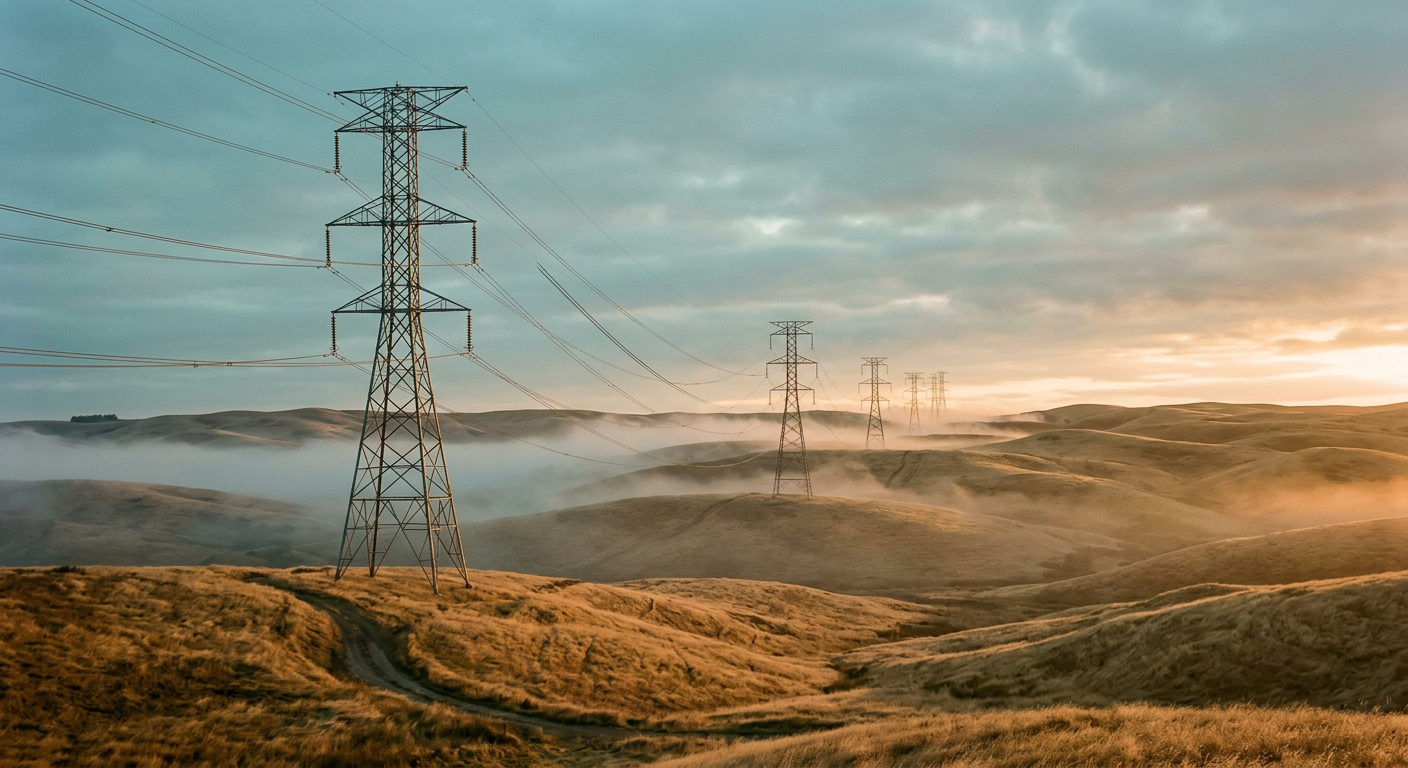
Pipe networks, power grids and road systems face the same trade-off as leaves. A tree-like layout is cheaper to build and simpler to operate. A looped, or meshed, layout costs more but can keep serving users when one link fails, and can cope better when demand moves from place to place.
Engineers already know this. Many urban water distribution systems are looped for reliability, and transmission grids are meshed so that power can reroute. What the leaf research adds is a set of mathematical tools and natural examples for thinking about where loops add the most value, how to arrange a hierarchy of sizes, and how a network can be grown step by step towards a robust form.
The 2016 paper explicitly listed power grids alongside plant and animal vasculature as optimised transport networks, and the slime mould study proposed its model as a possible guide to network design. Both, however, are models and laboratory results, not deployed engineering methods.[5],[6]
The limits of the analogy
Biological analogies are appealing, and they can be misleading. Several differences matter.
Leaves and pipes optimise for different things. A leaf's network is shaped by photosynthesis, mechanical support, the cost of building tissue and the threats it faces, such as insects. A water utility is shaped by pressure requirements, water quality, regulation, existing streets and budgets.
Scale and time differ. A leaf lives for a season or a few years and can be replaced. Infrastructure lasts decades and is expensive to change. A failure mode that a plant can tolerate, losing part of one leaf, may be unacceptable in a hospital's water supply.
Flows differ. Water in a leaf is pulled by evaporation through very small channels. Stormwater, drinking water and electricity each follow different physics.
And selection is not design. Evolution produces arrangements that work well enough in a particular environment, with historical constraints. The best reason to study leaves is not that nature is always optimal, but that it offers tested solutions to trade-offs that engineers also face.
What the research shows
The clearest lesson from leaf veins is about priorities. A network built only for efficiency under ideal conditions is fragile. A network that includes some redundancy, in the right places, can keep working when parts fail and when demand changes. Peer-reviewed theory and experiments on real leaves support that idea.
How far it translates into better pipes, grids or drainage is a separate and still open question. The research offers models and principles. Turning them into engineering practice requires the slower work of testing them against real systems, real costs and real failures.
Sources & Further Reading
- 1.
- 2.Damage and Fluctuations Induce Loops in Optimal Transport Networks(opens in a new tab)
Physical Review Letters, 2010
- 3.Fluctuations and Redundancy in Optimal Transport Networks(opens in a new tab)
Physical Review Letters, 2010
- 4.Leaf palmate venation and vascular redundancy confer tolerance of hydraulic disruption(opens in a new tab)
Proceedings of the National Academy of Sciences, 2008
- 5.Global Optimization, Local Adaptation, and the Role of Growth in Distribution Networks(opens in a new tab)
Physical Review Letters, 2016
- 6.
- Content type
- Explainer
- Author
- It’s Important
- Published
- Reviewed
- Editorial basis
- Research-based editorial
Filed under Science topic
Spotted an error? Report it to us.