
What Cities Can Learn From Pollinators
Bees, hoverflies, butterflies and other flower visitors respond to how a city is built and managed. Following them reveals how urban ecosystems actually work, and why a beehive on a roof is not the same as a healthy pollinator community.
It’s Important
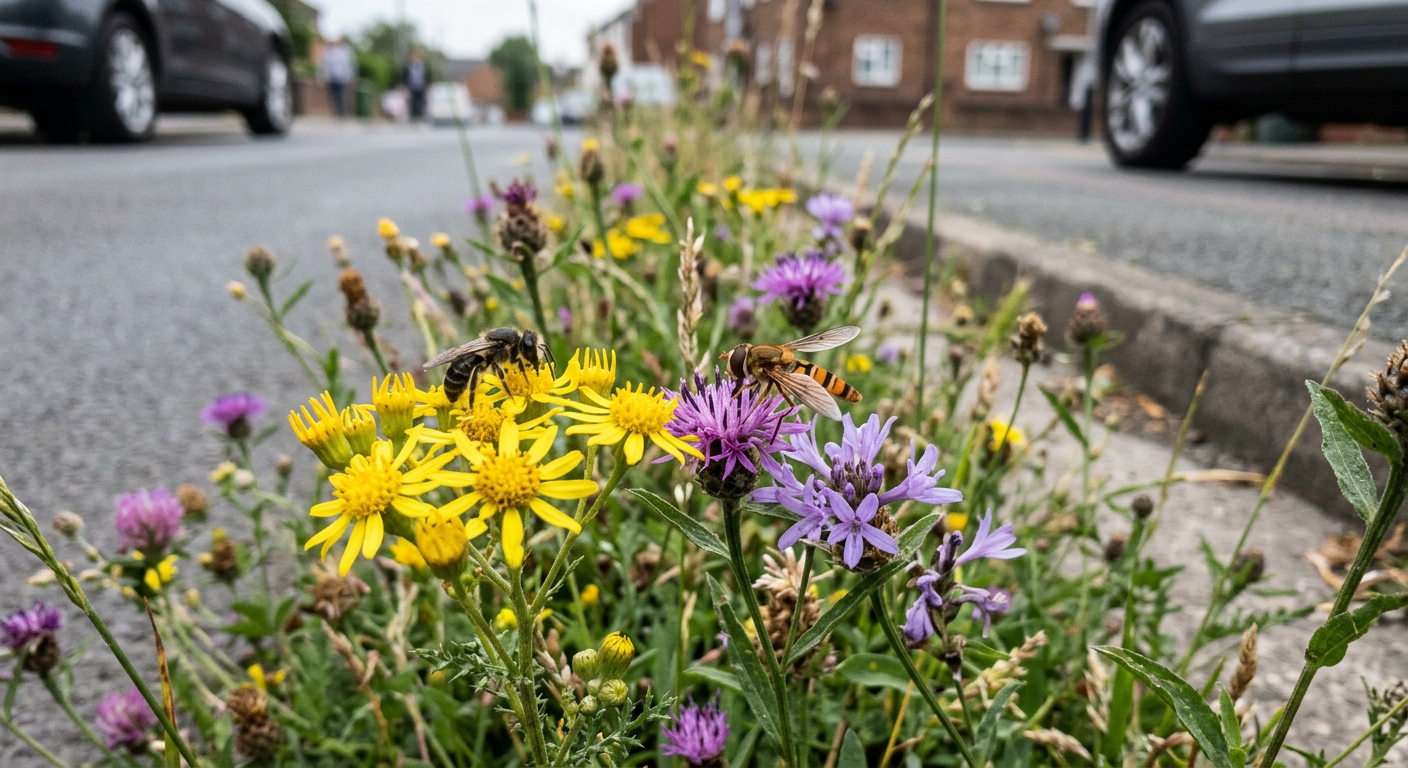
Cities are usually described as places where nature has been pushed out. Pollinators complicate that picture. Studies in British cities have found bee communities as rich as those in farmland, and some urban land uses act as genuine hotspots for flower-visiting insects. Other pollinators fare less well in the same places.
This explainer asks what those differences reveal. Pollinators are small, mobile and closely tied to flowers and nesting sites, so they respond quickly to decisions about planting, mowing, paving and pesticides. By the end, the reader should understand which parts of a city tend to support pollinators, why "pollinator" does not mean "honey bee", and where the evidence is strong or still incomplete.
Not one insect but many
The word pollinator covers a wide range of animals. In most temperate cities the main groups are bees, hoverflies, butterflies and moths, along with beetles, wasps and other flies. Their needs differ. A bumblebee colony needs flowers across a long season. Many solitary bees are active for only a few weeks and forage within a short distance of where they nest. Hoverfly larvae often develop in places that have nothing to do with flowers, such as decaying plant matter, standing water or aphid colonies. Butterfly caterpillars usually depend on particular food plants that are not the same as the flowers adults visit.
Honey bees are a special case. They are managed livestock, kept in hives and moved or multiplied by people. They are important pollinators, but their numbers say little about the state of wild species, and in some settings they compete with them for the same flowers.
The distinction matters for food as well as for nature. A study of more than 40 crops grown around the world found that wild pollinators improved fruit set in a way that honey bees did not replace: visits by wild insects increased fruit set by roughly twice as much as equivalent visits by honey bees, and the benefit held regardless of how many honey bees were present.[3]
The global assessment of pollinators published by the Intergovernmental Science-Policy Platform on Biodiversity and Ecosystem Services (IPBES) in 2016 drew the same broad distinction. It treated wild and managed pollinators as separate parts of the picture, and identified land-use change, pesticides, pathogens, invasive species and climate change among the pressures acting on them.[4]
What the urban surveys found
One of the most cited comparisons was carried out across the UK and published in 2015. Researchers recorded which insects visited which flowers at 36 sites, each one square kilometre, split between urban areas, farmland and nature reserves. Overall, the abundance and species richness of flower visitors did not differ significantly between the three landscape types.[1]
The details were more revealing than the totals. Bee abundance was similar across landscapes, but bee species richness was higher in urban areas than in farmland. Hoverflies showed the opposite pattern: they were more abundant in farmland and nature reserves than in towns. Urban pollinator communities were also more similar to one another from place to place than those in the countryside.[1]
That combination is typical of urban ecology. A city can support a lot of species without supporting all of them, and it can favour generalists that do well in many places over specialists with narrower needs. "Cities are good for pollinators" and "cities are bad for pollinators" are both too simple.
A review of research on urban bees reached a similar conclusion from another direction. It found that urban landscapes can hold native bee species that are absent from nearby rural land, and argued that because pollinators have relatively small requirements for range and nesting, meaningful conservation is achievable in cities. It also noted that urban conservation programmes have historically invested more in education and outreach than in measurable outcomes for species.[5]
Gardens, allotments and the shape of a city
If cities can support pollinators, the next question is where. A larger follow-up study surveyed flowers and pollinators at 360 sites covering all major land uses in four British cities. Residential gardens and allotments stood out as hotspots. Gardens mattered mainly because of their sheer extent: added together, they cover a large share of urban land. Allotments mattered because of their high pollinator diversity and their outsized influence on how robust the whole city's plant-pollinator network was to the loss of species.[2]
The same study found that pollinator abundance in gardens was positively associated with household income. That is a reminder that urban nature is shaped by social and economic conditions as well as by ecology: who has a garden, how much time and money goes into it, and what is planted there.[2]
For planners, this shifts attention away from single showcase sites and towards the combined effect of thousands of small spaces. A city's pollinator habitat is mostly private, scattered and managed by people who never think of themselves as land managers.
Flowers through the year
Pollinators need food across their whole active season, not just at a peak. A park bed planted for a spectacular early-summer display can leave little in late summer, and a mown lawn offers almost nothing at any time. Variety matters for the same reason. Bees with short tongues, bees with long tongues, hoverflies and butterflies feed most easily from differently shaped flowers, so a planting scheme dominated by one form serves only part of the community.
This is one area where urban areas can have an advantage. Gardens contain a mix of native and non-native plants with different flowering times, which can extend the season. The trade-off is that some ornamental varieties, particularly double-flowered forms, offer little accessible nectar or pollen. A city full of flowers is not automatically a city full of food for insects.
Nesting: the half of the problem that is easy to miss
Flowers are only half of what a pollinator needs. Many wild bees nest in the ground, often in bare or sparsely vegetated soil that is warm and well drained. Others use hollow stems, beetle holes in dead wood or gaps in old walls. Hoverflies and butterflies need places for their larvae to develop. These requirements are easily removed by tidiness: resurfacing bare patches, clearing dead stems in autumn, filling cracks and removing deadwood.
Because nesting sites are less visible than flowers, they are often left out of planting schemes. A border full of nectar-rich plants surrounded by paving and close-mown grass may feed insects that have nowhere nearby to raise the next generation.
Verges and corridors
Habitat fragmentation is one of the defining features of cities. Patches of suitable ground are separated by buildings, roads and hard surfaces, and small insects can struggle to cross them. That raises the question of whether linear features such as road verges, railway embankments and riverbanks can connect habitat across a city.
A 2020 review of 140 studies looked specifically at road verges. It concluded that verges are often hotspots of flowers and pollinators, which it described as well established. It also found that traffic and road pollution can kill pollinators and cause other harm, again well established, but that the available evidence suggested the benefits of verges outweighed those costs. That last finding was rated as established but incomplete.[6]
The review's grading is a useful model for how to talk about urban pollinator measures. Some benefits are well supported, others are plausible but not yet demonstrated at scale. Mowing verges less often, and at times that allow plants to flower and set seed, is a practical change that many councils have adopted. Whether a network of verges works as a true corridor, letting populations move and mix across a whole city, is harder to measure.
Pesticides and other pressures
Cities are sometimes described as refuges because they are thought to have lower pesticide exposure than intensive farmland. That assumption is reasonable in many places but not guaranteed: pesticides are also used in parks, on hard surfaces, along transport routes and in private gardens. The risks are clearest from farmland research. A field study published in 2015 found that a neonicotinoid insecticide used as a seed coating on a flowering crop had serious negative effects on wild bees, and suggested that the contribution of pesticides to wild bee decline may have been underestimated.[7]
Pesticides are one pressure among several. England's National Pollinator Strategy, a ten-year government plan, framed the problem as a range of pressures from habitat loss to pests and diseases, and covered both food production and wider biodiversity.[8]
The beehive problem
Urban beekeeping has grown in many cities, and putting hives on rooftops is sometimes presented as a way to help pollinators. The evidence suggests caution.
Research in Paris compared wild pollinator activity with the density of honey bee colonies in the surrounding area. Wild pollinator visits to flowers were lower where there were more hives nearby, measured within both 500 metres and one kilometre. Large solitary bees and beetles were among the groups affected within the closer radius. The authors noted that city pollinator policies have often focused on installing honey bee colonies.[9]
The Paris study shows a correlation rather than proving that hives caused the decline in wild visits, and results in other cities may differ. But it supports a simple principle. Adding a managed species does not create habitat. If flowers are limited, more honey bees means more competition for the same resources. Planting and protecting nesting sites helps wild and managed pollinators alike. Adding hives on its own mainly adds honey bees.
What this reveals about urban ecosystems
Following pollinators through a city brings out several features of urban ecosystems more generally. They are patchy, and their value depends on how patches add up rather than on any single site. They are heavily shaped by private decisions and by income, not just by public policy. They reward variety in plants, in timing and in structure, and they are sensitive to tidiness in ways that are easy to overlook.
They also show how important it is to measure the right thing. Counting hives, or the number of flowers planted, is easier than recording which species are present and whether they are breeding. The more careful studies make clear that the answer depends on which pollinators are counted, where and how.
For a city that wants to support pollinators, the evidence points to a small set of practical moves: protect and add diverse flowering plants across the season, leave space for nesting, mow and tidy less, reduce pesticide use, and treat gardens, allotments and verges as parts of a single system. None of these needs a rooftop hive. All of them depend on noticing the smaller, less visible insects that do much of the work.
Sources & Further Reading
- 1.Where is the UK's pollinator biodiversity? The importance of urban areas for flower-visiting insects(opens in a new tab)
Proceedings of the Royal Society B, 2015
- 2.A systems approach reveals urban pollinator hotspots and conservation opportunities(opens in a new tab)
Nature Ecology & Evolution, 2019
- 3.
- 4.The assessment report on pollinators, pollination and food production(opens in a new tab)
Intergovernmental Science-Policy Platform on Biodiversity and Ecosystem Services (IPBES), 2016
- 5.The city as a refuge for insect pollinators(opens in a new tab)
Conservation Biology, 2016
- 6.Enhancing road verges to aid pollinator conservation: A review(opens in a new tab)
Biological Conservation, 2020
- 7.
- 8.National Pollinator Strategy: for bees and other pollinators in England(opens in a new tab)
Department for Environment, Food & Rural Affairs (UK Government)
- 9.
- Content type
- Explainer
- Author
- It’s Important
- Published
- Reviewed
- Editorial basis
- Research-based editorial
Filed under Environment topic · Cities system · Food system
Spotted an error? Report it to us.