
Rebuilding the Mangrove Edge in the Mekong Delta
Can Tho City and Ca Mau Province, Viet Nam
Coasts
Environment
2024–2026 · ongoing
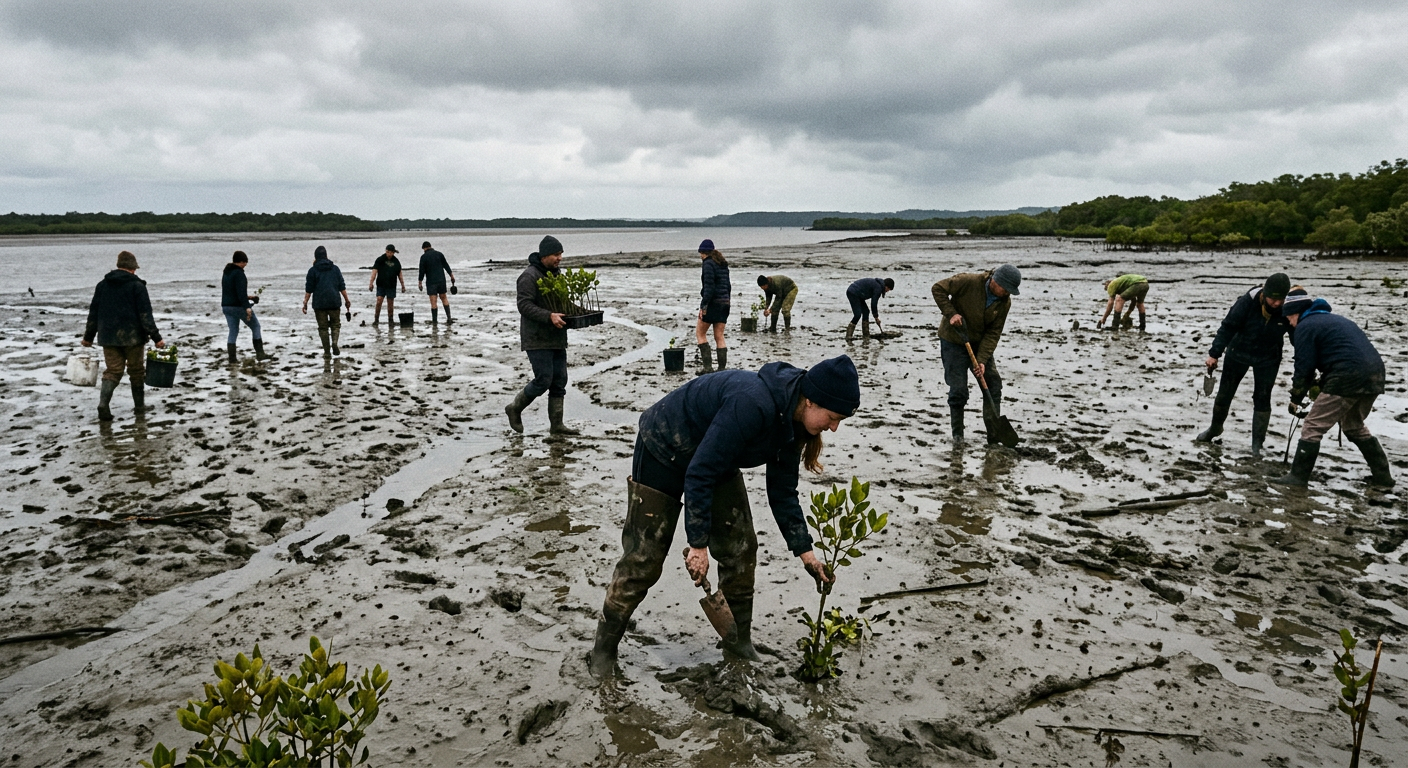
IUCN is implementing the three-year project “Increasing Coastal Resilience in the Mekong Delta through Mangrove Restoration and Hybrid Nature-based Solutions” (1 January 2024 – 31 December 2026), funded by The Coca-Cola Foundation. It began in the former provinces of Soc Trang and Bac Lieu; after Viet Nam’s 2025 provincial merger these areas sit within Can Tho City and Ca Mau Province, the names IUCN now uses.
- 21[1]
- Farms converted by November 2025
- 45[1]
- Households targeted by the pilot
- 2.5 cm[1]
- Annual land subsidence cited by IUCN
Challenge
The Mekong Delta holds about three-quarters of Viet Nam’s mangroves, and they are disappearing. IUCN links the loss to reduced sediment supply, sea-level rise, sea dikes, shrimp farming and groundwater pumping, which drives land subsidence of about 2.5 centimetres a year — around five times the rate of global sea-level rise. Mangroves are caught in a “coastal squeeze” between dikes and rising water, and new trees planted outside the dikes are quickly eroded.
Approach
Instead of planting more trees seaward, the project tries to make room for mangroves inside the dike by changing how shrimp is farmed. It pairs natural and assisted mangrove regeneration with converting large open-air shrimp ponds to Integrated Multi-Trophic Recirculating Aquaculture Systems (IMTA-RAS), which IUCN says can produce around 20 times more shrimp per unit area with lower disease risk. Because the water recirculates, farms need far less pumped groundwater, which targets one cause of subsidence. The aim is to show that the hybrid model is technically and financially viable for 45 shrimp-farming households managing 135 hectares.
Solution
By November 2025, IUCN reported that 21 farms had converted to IMTA-RAS with mangrove restoration, and a return-on-investment analysis had been completed to inform lenders. At a December 2025 event, Agribank said it could offer unsecured preferential loans for sustainable models of up to VND 300 million (about US$10,000) per household. IUCN is explicit about the obstacles: many farmers are hesitant because of high upfront conversion costs and climate risk, and the project plans to test other species such as fish and crabs to find lower-risk options. Earlier IUCN updates gave different interim figures for households and area as the project grew; we use the latest. The project is scheduled to run until 31 December 2026 and had not reported completion at the time of review.
Reviewed . Figures are taken from the sources below as published; images on this page are illustrative, not documentary photographs of the project.
Sources & Further Reading
- 1.
- 2.
- 3.
- 4.
Know a projectwe should follow?
Know a story, project, problem or idea that deserves attention? Tell us about it. We welcome suggestions, expertise, partnerships and opportunities to collaborate.
 Established 2026